
POTTERY WELLNESS COURSE
A Deep Immersion into Craft, Rhythm & Practice
Each year, a small group of international participants are welcomed into the studio for a period of focused immersion — a time to make, observe, refine, and integrate. The approach is holistic by nature: ceramics understood not only as a craft, but as a discipline and a way of orienting oneself in work and life.
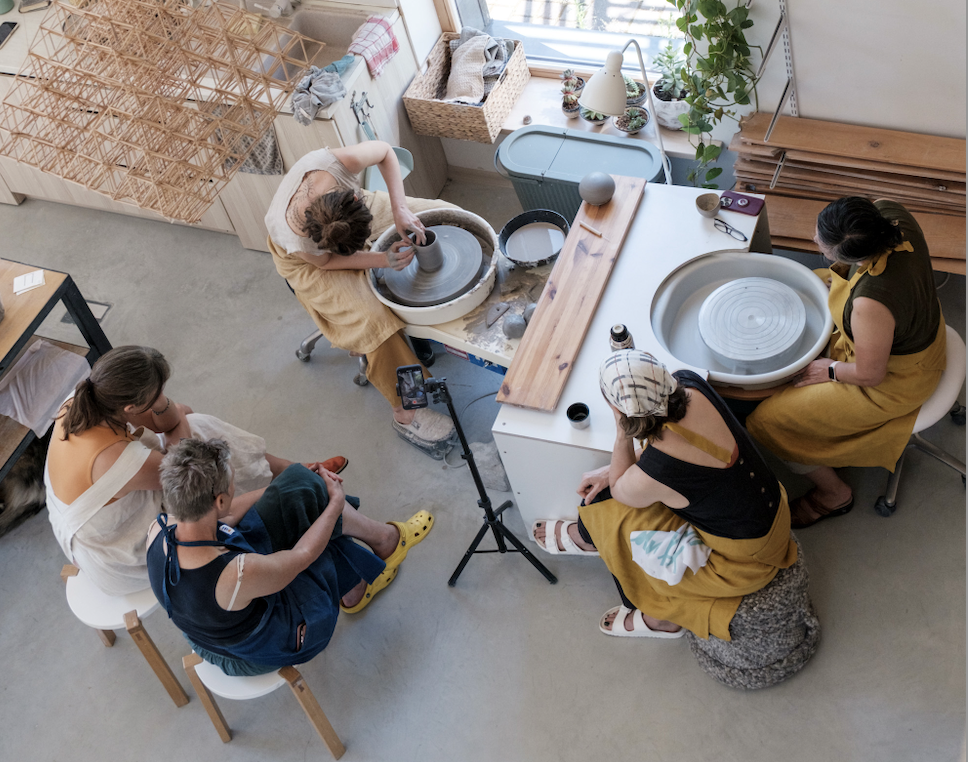
During this time, participants are guided through core ceramic processes such as wheel throwing, glaze development, and traditional Baltic Obvara firing. Equally important are the quieter, often unseen layers of studio life: decision-making, pacing, repetition, refinement, and the rhythms that sustain a long-term practice. These elements are absorbed through proximity, shared time, and daily presence.
Living and working on site allows learning to extend beyond scheduled sessions and into everyday life. This closeness creates a natural container for observation, questions, rest, and gradual skill development — without pressure to perform, compete, or produce for outcome.
Competence and confidence emerge through sustained presence, repetition, and attunement over time. This course is designed to offer exactly that: continuity, space, and the conditions needed for meaningful progress.
WHAT IS UNIQUE ABOUT THIS opportunity?
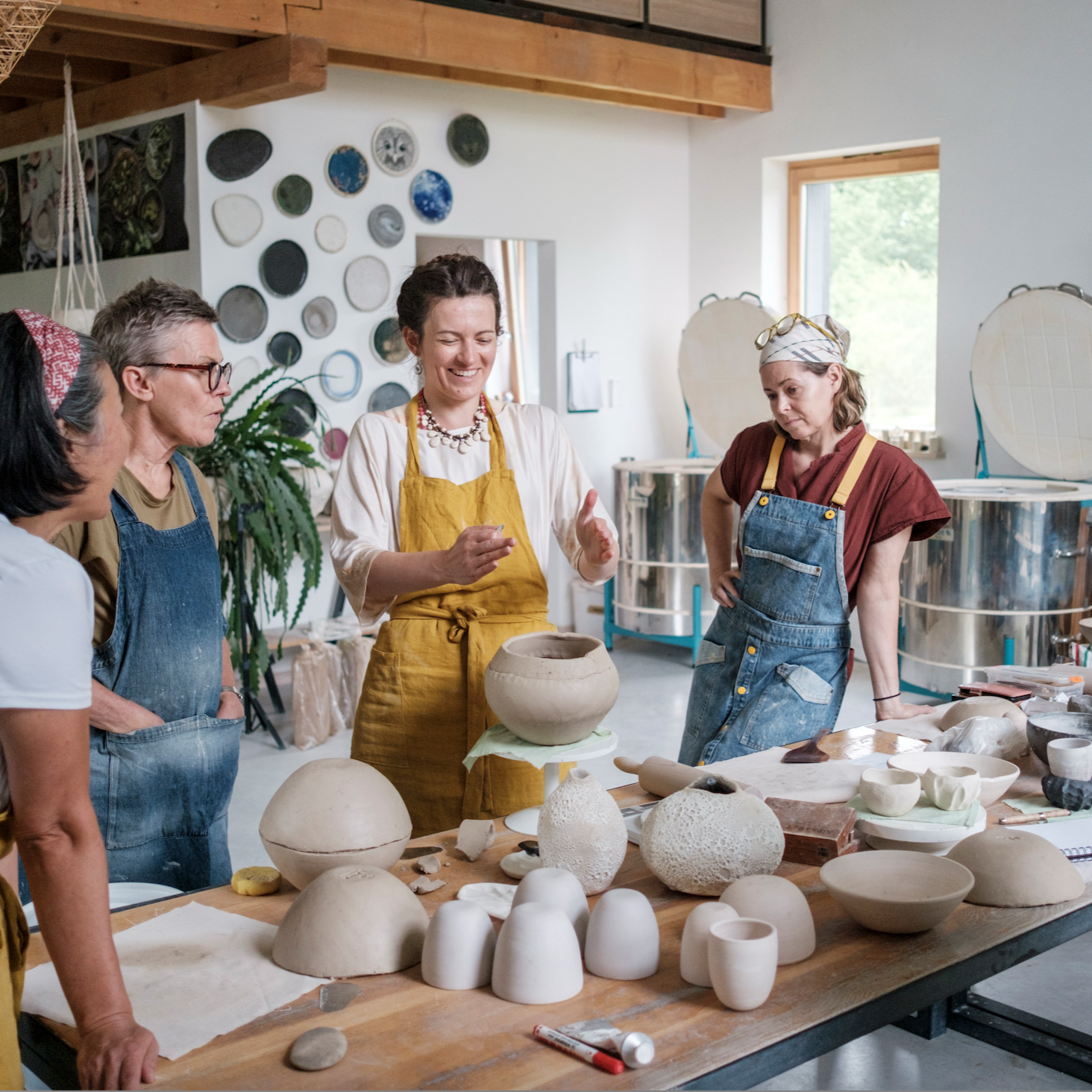
This program sits at the intersection of a structured pottery course and an artist residency. It offers both dedicated time and space to develop your own work at your own pace, alongside regular guidance and shared studio rhythm.
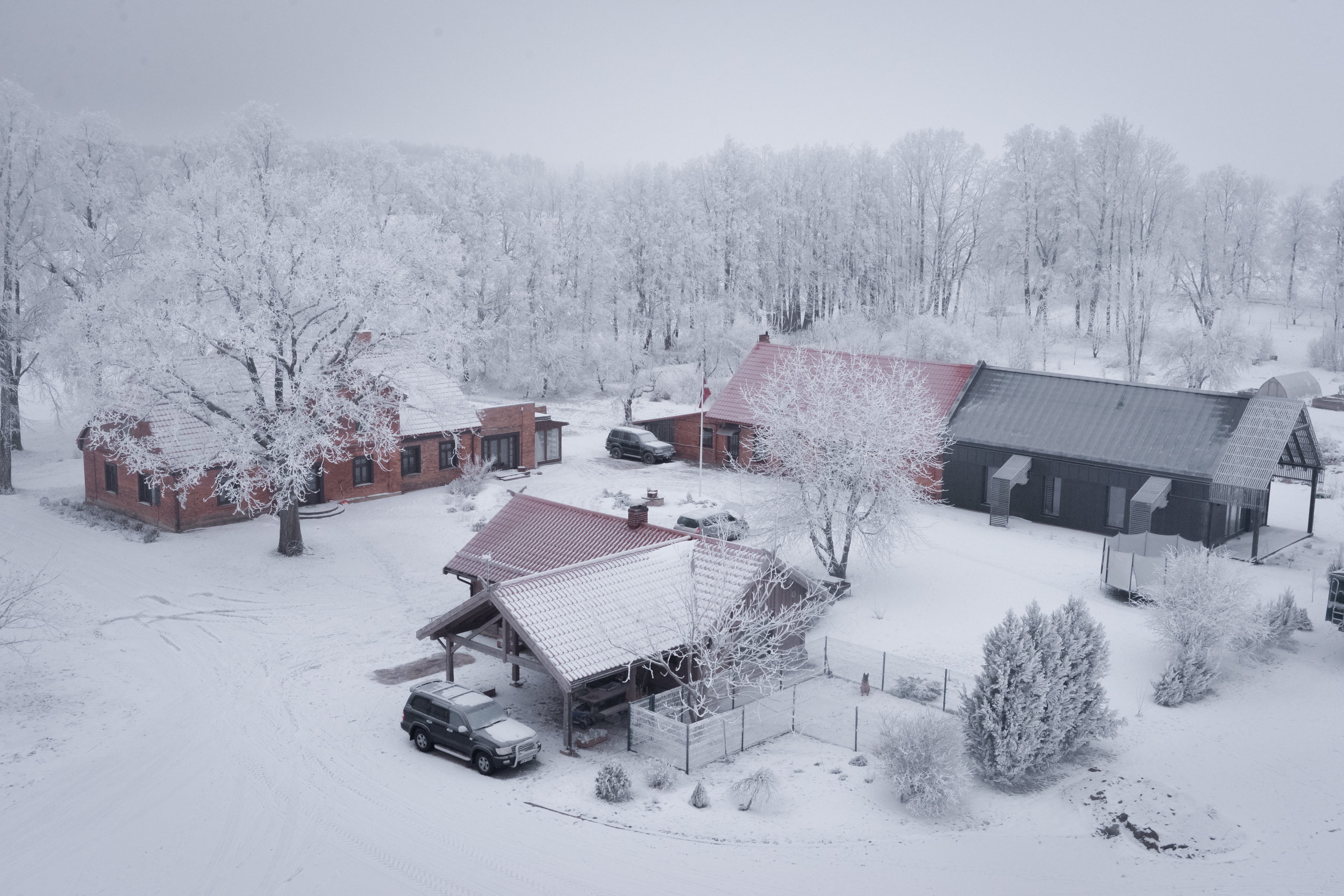
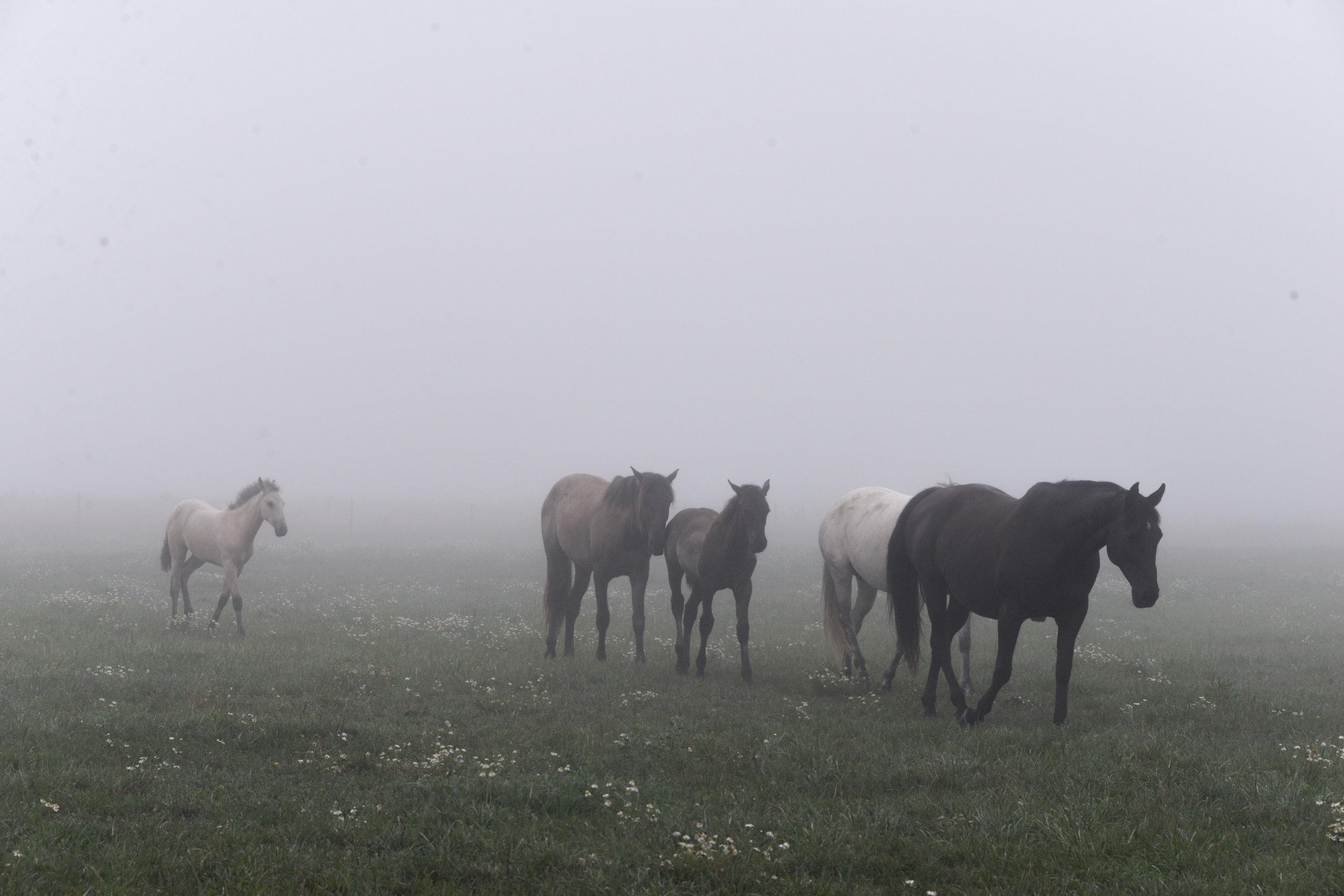
Set in a quiet rural landscape, the studio is surrounded by garden, animals, and open land — creating conditions that support focus, rest, and a slower, more attentive way of working.
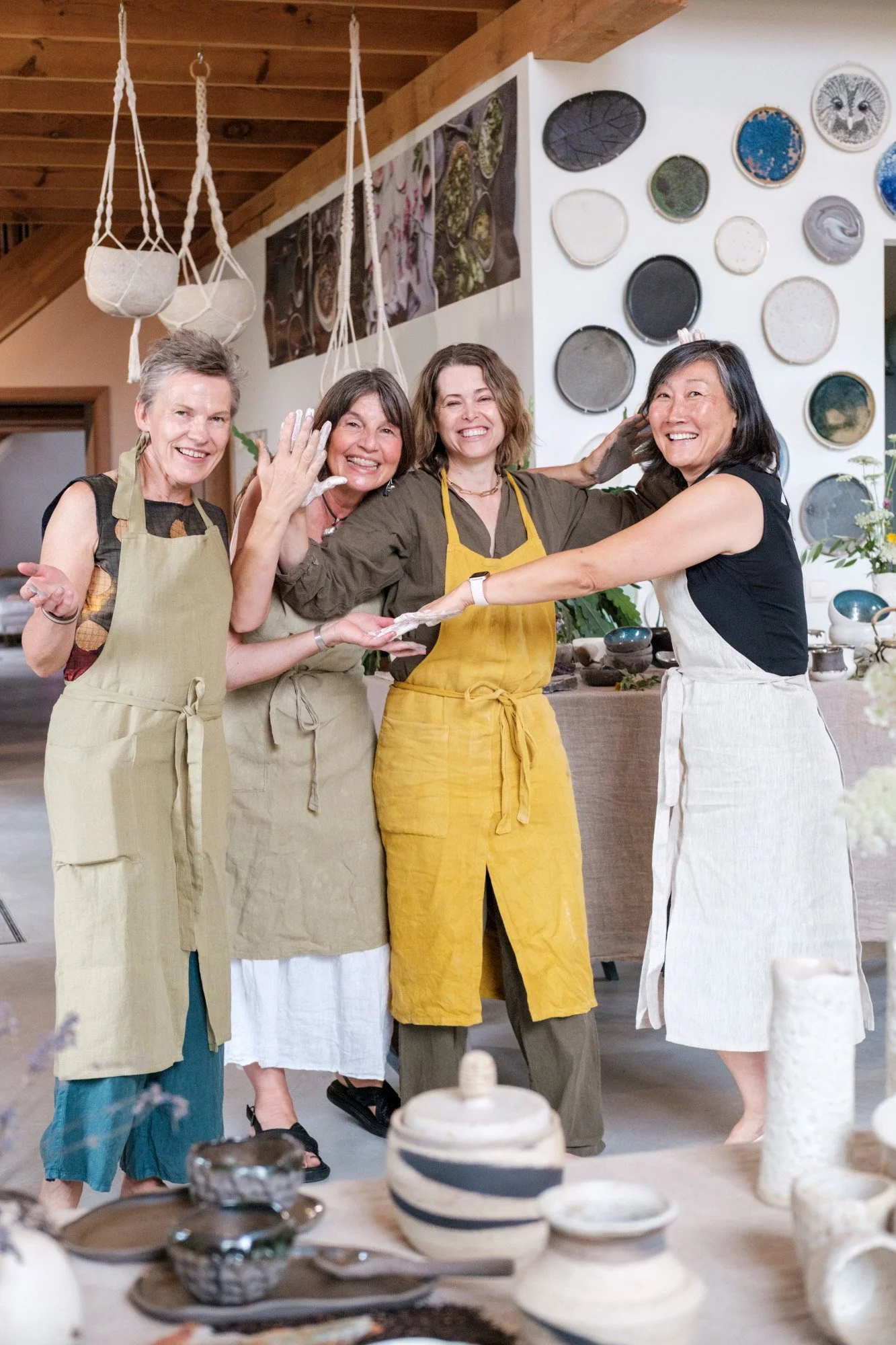
The group is international and intentionally small, bringing together people at similar stages of commitment who are drawn to craft as a long-term practice rather than a short-term pursuit. Shared meals, studio time, and daily rhythms foster a sense of quiet community without pressure or comparison.
Workshops combine practical demonstrations, technical discussion, and insight into my approach to ceramics — how decisions are made, how processes are refined, and how a studio practice is sustained over time.
Beyond technique, the program offers exposure to the wider realities of studio pottery: pacing, material choices, workflow, business side of ceramics and the practical and philosophical considerations of working with clay as a livelihood or lifelong discipline.
The personal setting of our home studio creates a grounded, welcoming environment where each participant is supported as an individual and encouraged to work with confidence, care, and autonomy.
What Past Participants Share
“This course is far beyond just a ceramics course… the tranquil calm surroundings, wholesome food, beautiful lodging, and presence of horses, cats and dog… the place simply induces a state of calm and presence, inevitably translating into your state when working with clay.”
— Yakeen Hafouda, UK
“I spent a beautiful four weeks at Laima’s ceramics studio… friendships to treasure forever… pottery skills blossomed. Laima is an exceptional teacher who generously shared her artistry.”
— Heidi Allen, USA
“I left home for a pottery class but returned with so much more… this experience far exceeded anything I could have imagined… Laima and her space came into my life with an entire package of wisdom.”
— Eliza, Romania
“I attended Laima’s one-week pottery course… it was like living the life of my dreams… complete beginners could make a beautiful teapot by day three because it was structured so cleverly and carefully! Laima showed me techniques before I knew what I needed.”
— Anna, Poland
“My course with Laima was something that changed my future as a human and my path in pottery forever… I found life-long friends with the same passion… This course is so much more than just pottery learning.”
— Aino, Finland
“Laima’s studio is the perfect balance of beauty and functionality… she fostered creativity and was generous in sharing her extensive knowledge. I left a better potter and human; I owe that to Laima.”
— Zoe Main, USA

Key Details — What Your Booking Includes
Course fee covers all core elements of the immersion, allowing you to fully settle into the studio rhythm without ongoing logistical decisions.
Included
Accommodation at our family home next to the studio
Daily access to the professional pottery studio
30+ hours of guided group instruction
Two individual one-on-one sessions on the pottery wheel
Weekly Friday community lunches
Welcome meal and closing dinner
Materials and firings*
Group exhibition in the studio at the end of the course
Individual photoshoot of you and your exhibited work
As part of the course process, one ceramic piece will remain in the studio’s permanent collection.
About the Program
This opportunity is best suited to potters who wish to deepen their skills within a quiet, rural setting and a fully equipped working studio.
It particularly suits those with a genuine curiosity about the wider life of studio pottery — including how a practice is organised, sustained, and shaped over time — whether or not they intend to pursue it professionally.
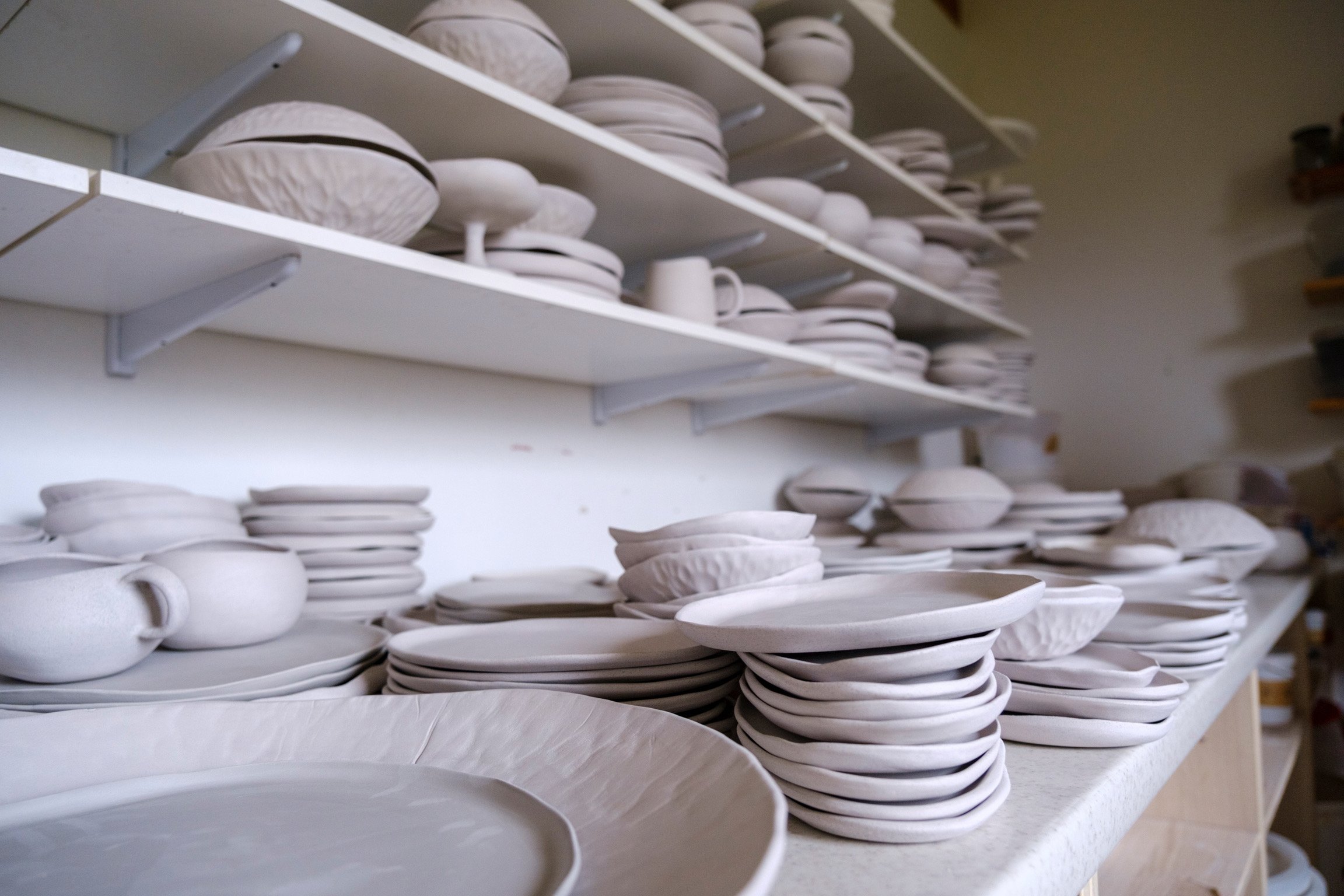

Location & Setting
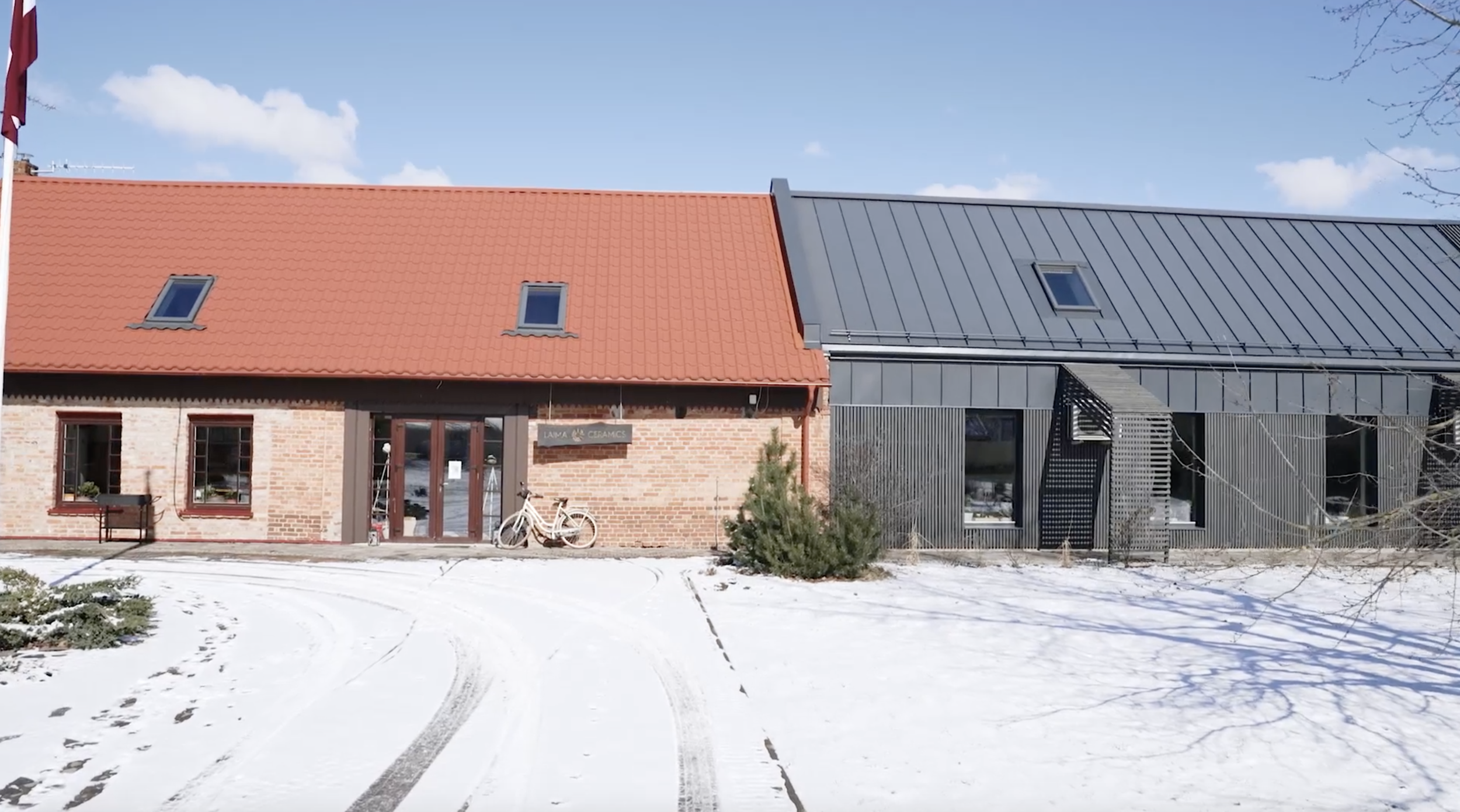
Laima Ceramics is located in the rural countryside of Zemgale, a region long known as the agricultural heartland of Latvia. The landscape here is wide and open, shaped by farming fields and long horizons.
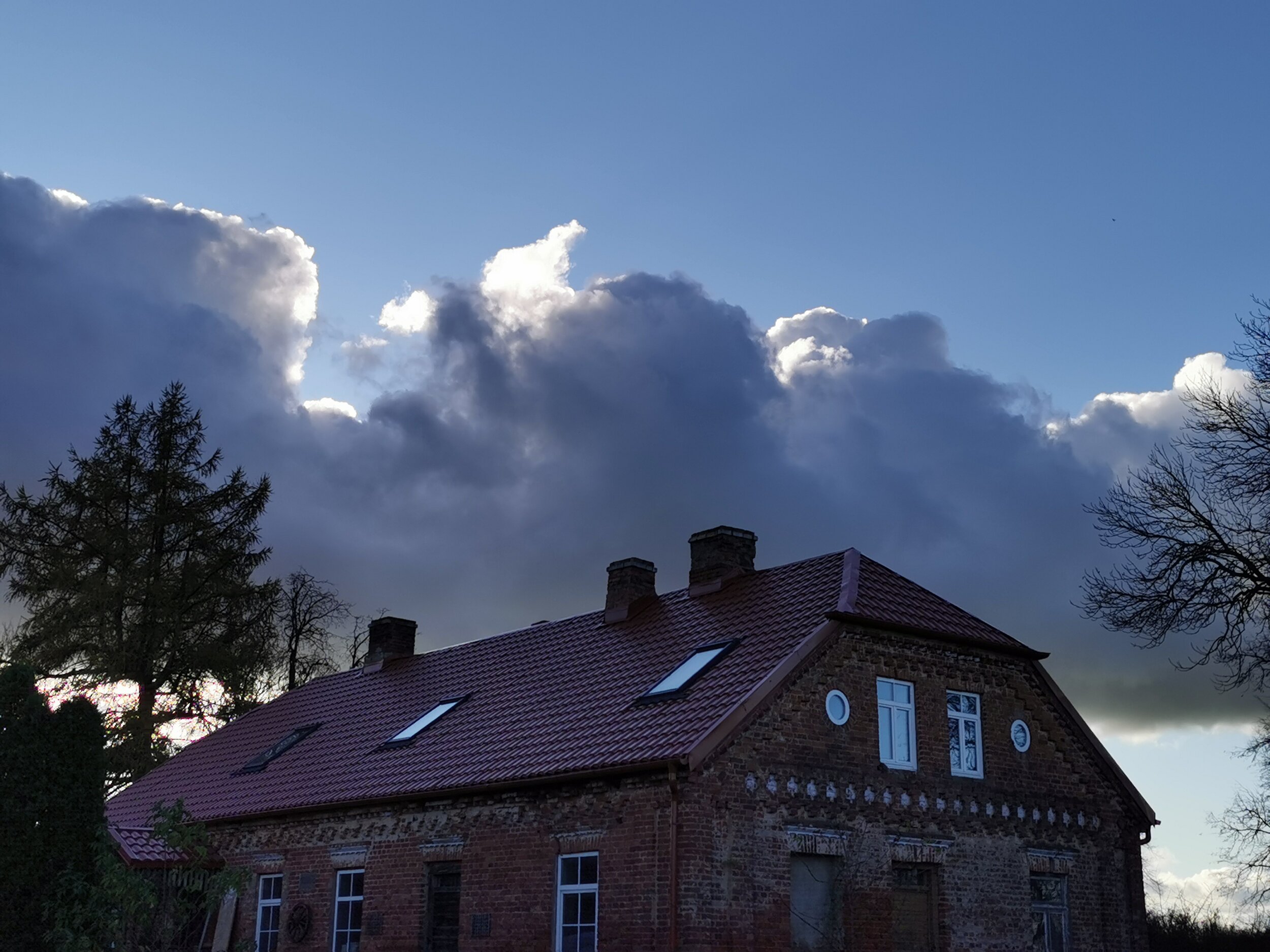
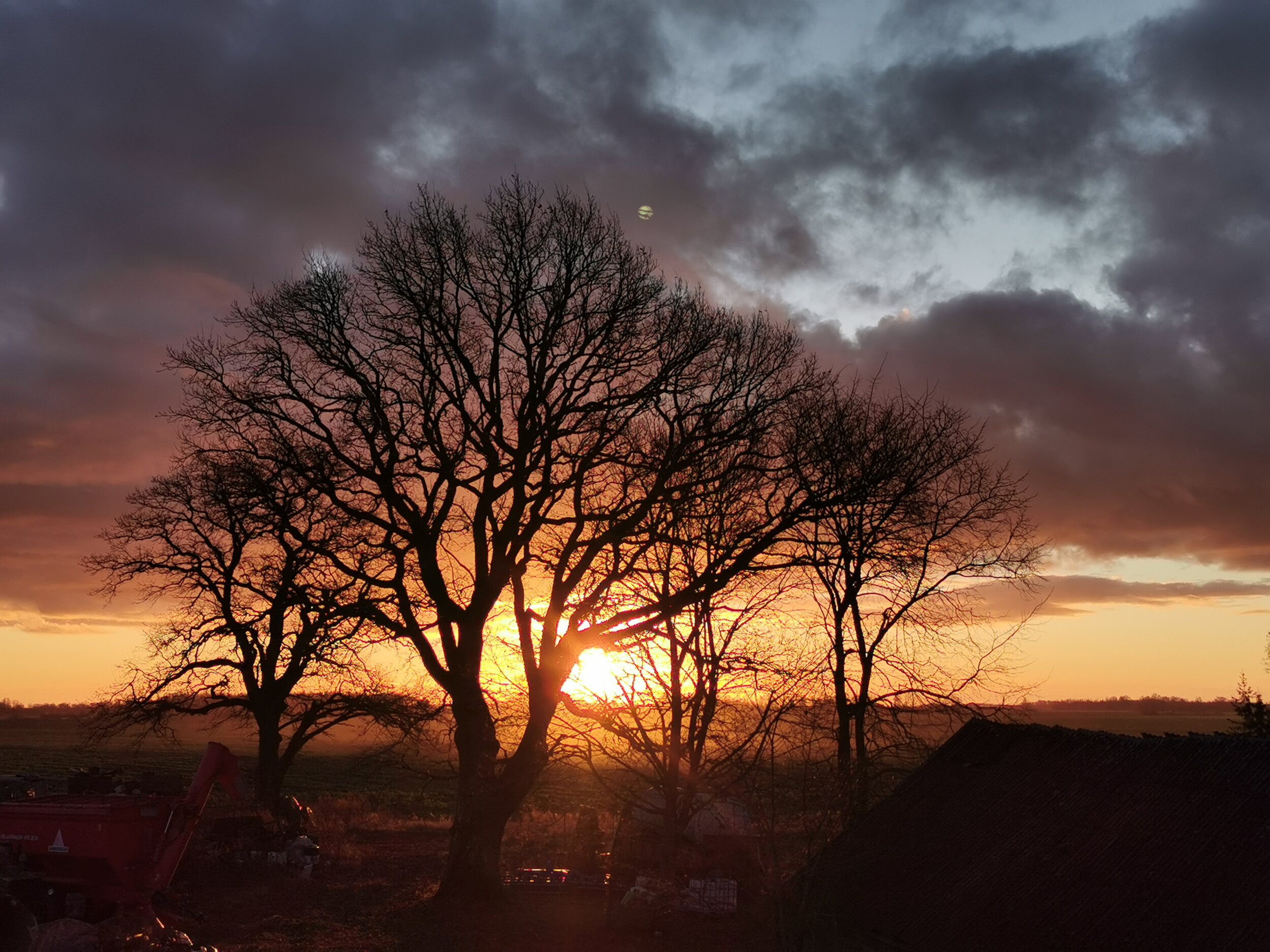
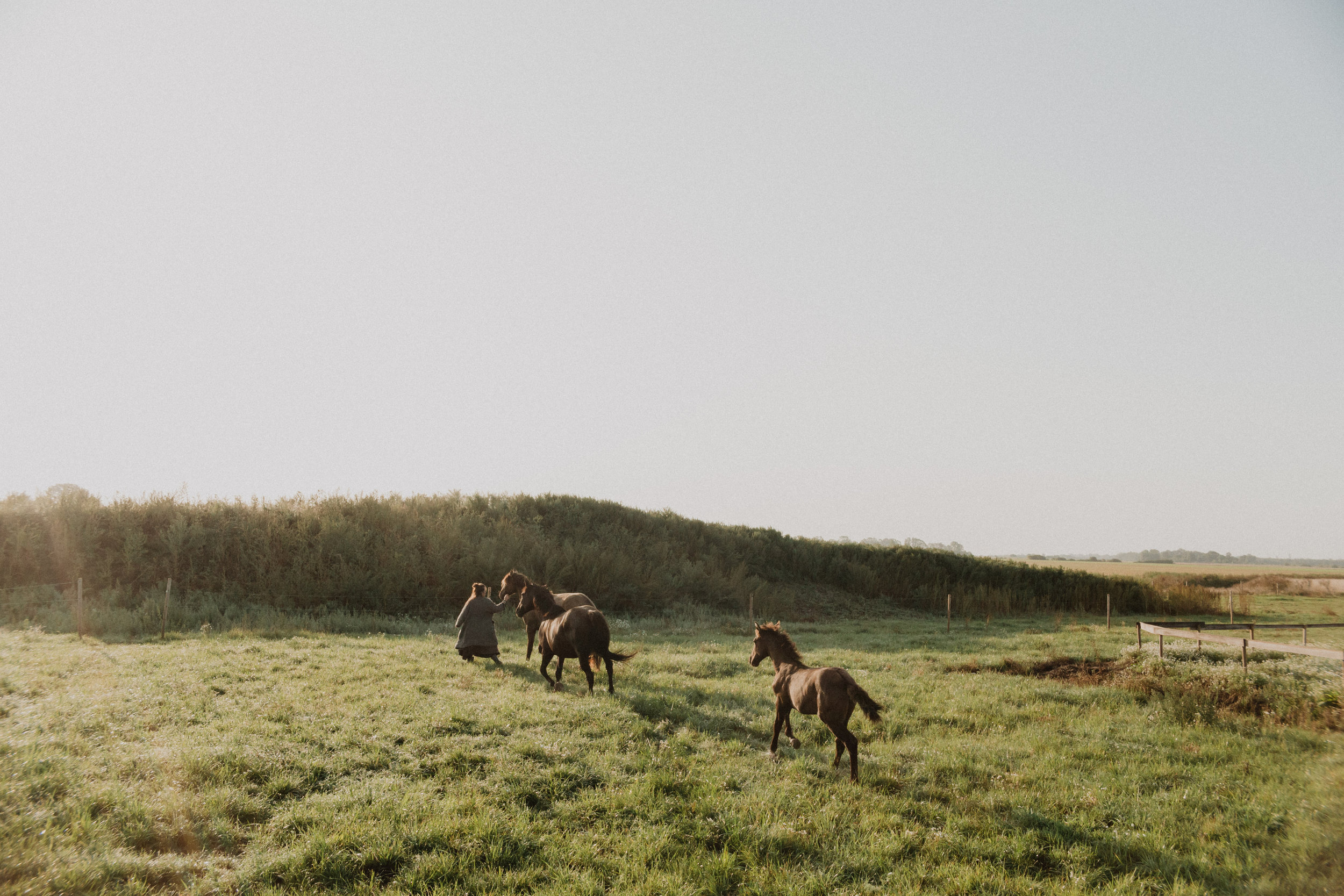
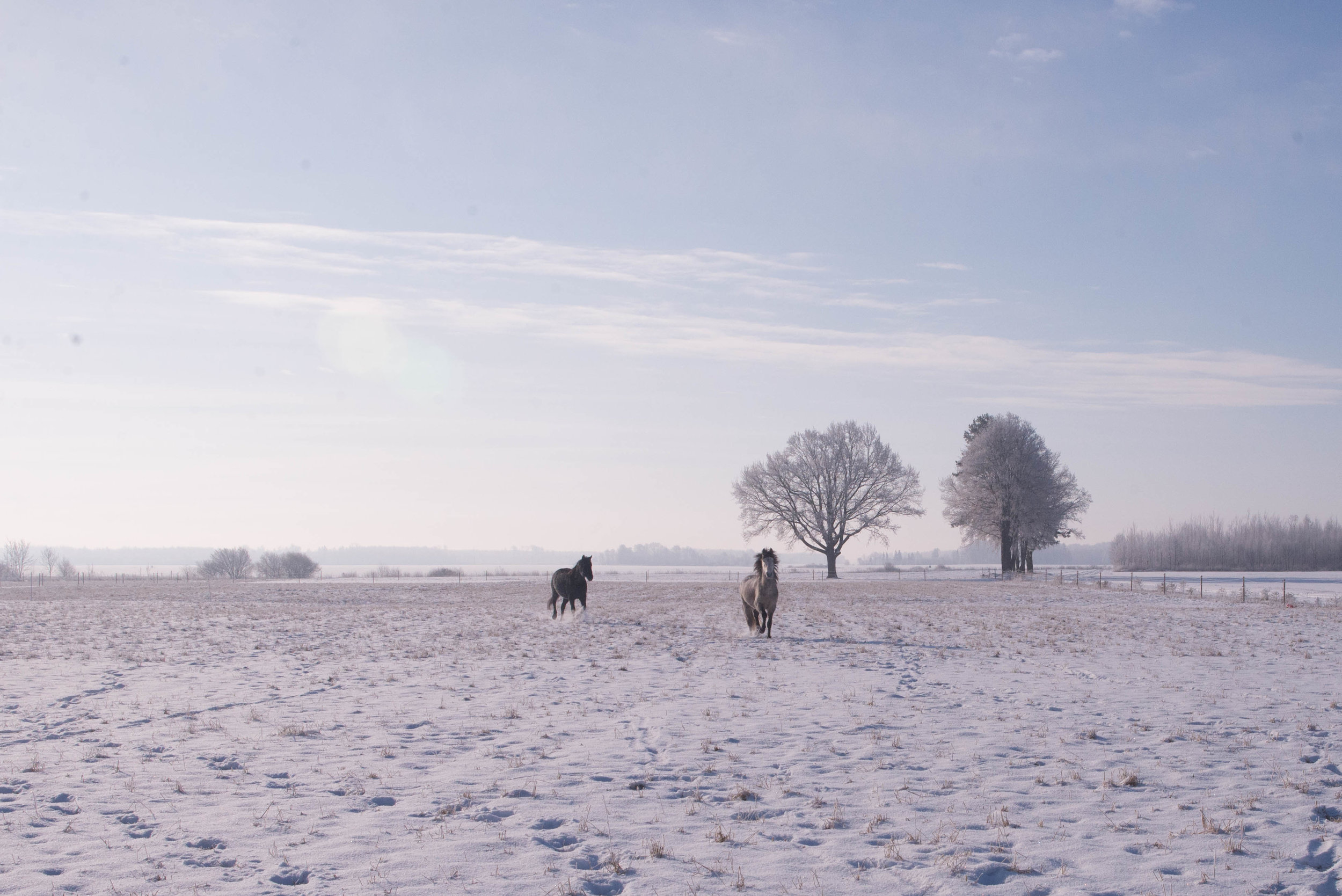
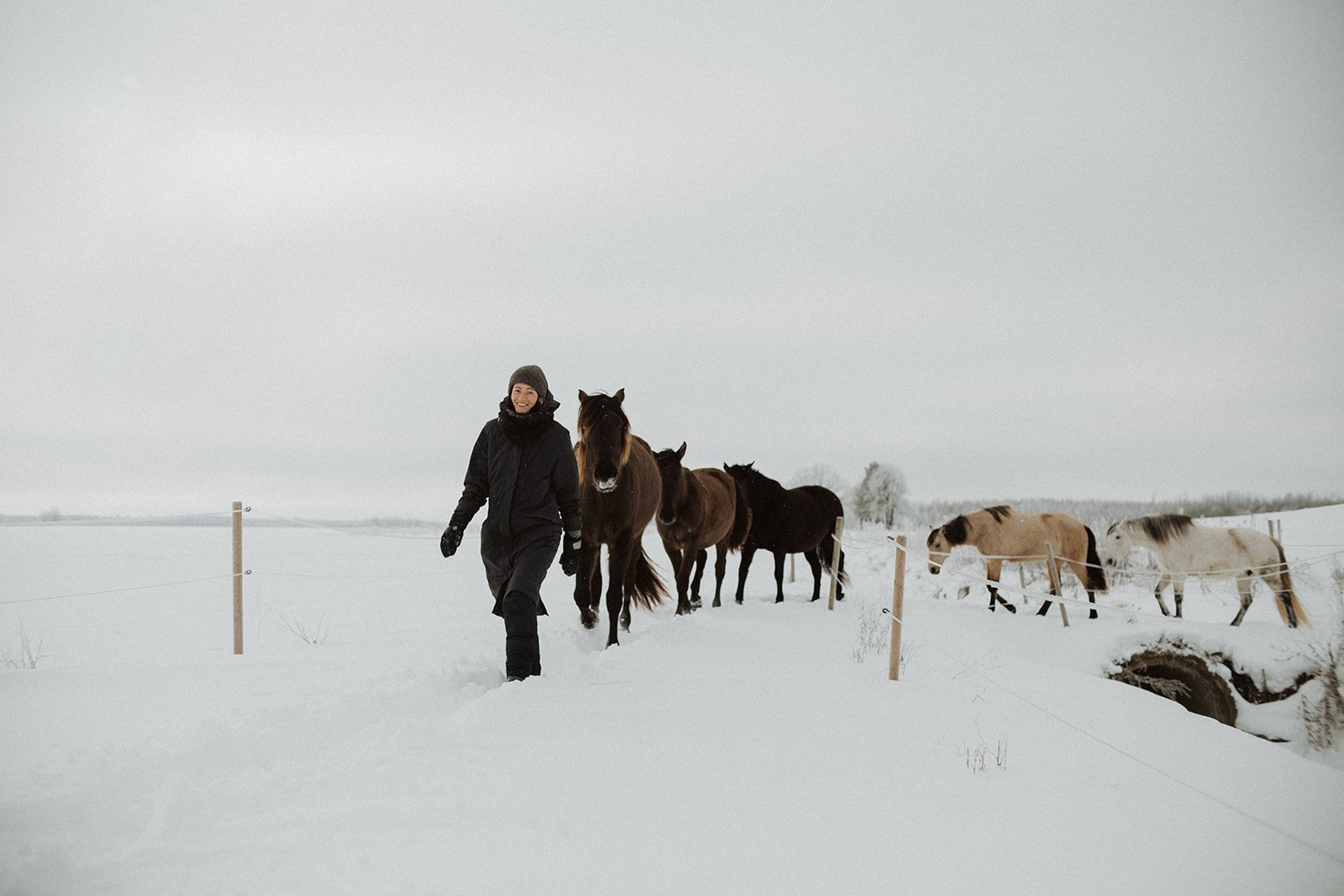
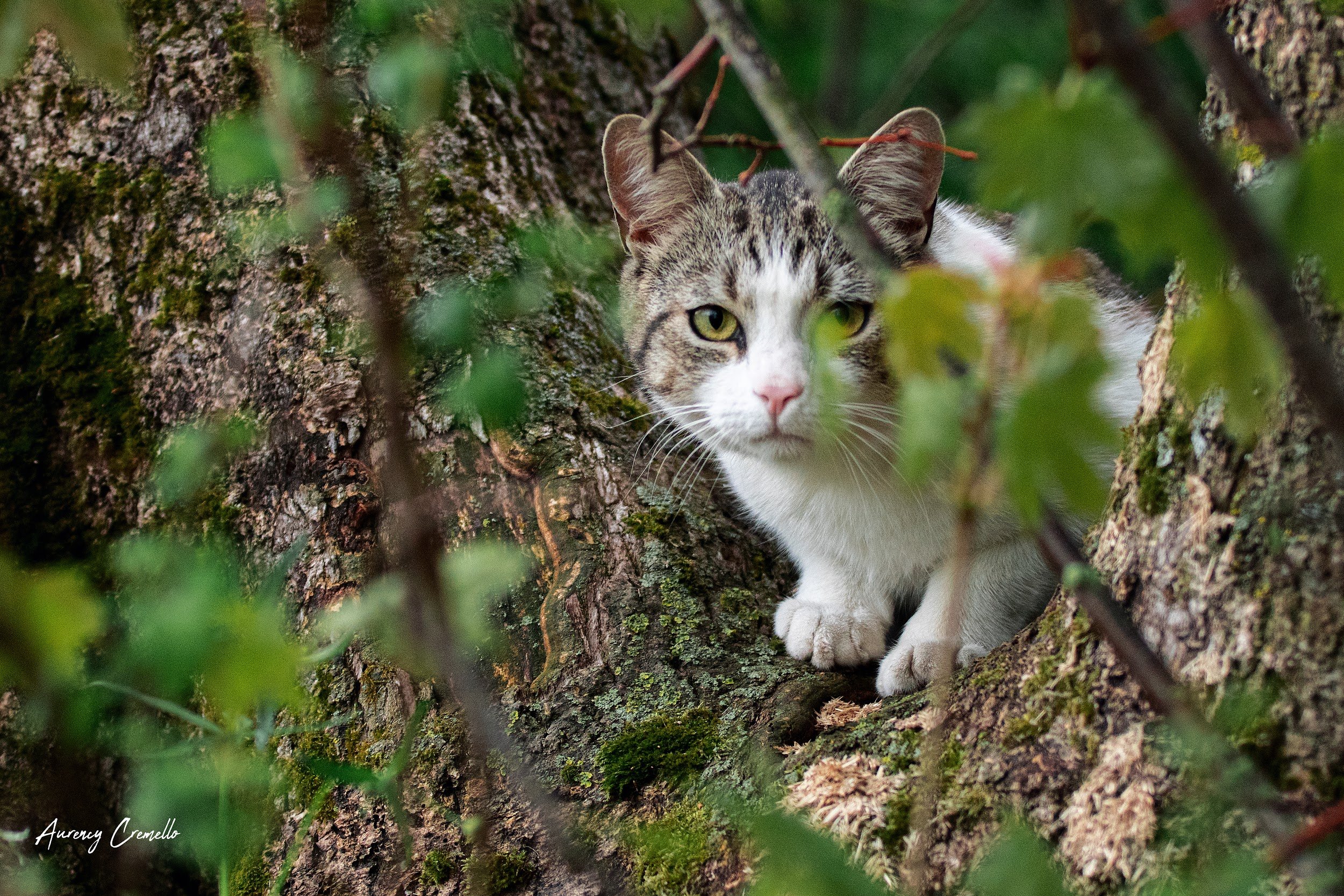
The studio is part of a family farm and small horse sanctuary, surrounded by grazing land, an old apple orchard, and working fields. Horses live and move through the landscape as part of daily life, offering a grounding presence rather than an attraction. Seasonal changes — light, weather, harvest, and rest — are felt clearly and naturally here.
The nearest town, Bauska, is approximately 20 km away and offers basic amenities, while Latvia’s capital, Riga, is about 70 km from the property and easily reachable by car or public transport. This distance creates a balance: rural seclusion without isolation.
Living and working on site means becoming attuned to the rhythms of the place — early mornings, long studio days, shared meals, and evenings that slow naturally with the light. The environment supports focus, repetition, and rest, making it particularly suited to those who value uninterrupted time and a close connection between work, land, and daily life.
This is not a retreat setting designed to distract or entertain, but a working rural environment that quietly supports sustained practice and presence.




Learning & Guided Sessions Include
Introduction and orientation of the studio, land, and facilities
Wheel-throwing demonstrations (stoneware & porcelain), from cylinders to teapots
Glaze development and application guidance
Dinnerware day — creating functional tableware for home or professional use
Traditional Baltic Obvara (Raku) firing workshop
Extruder vase workshop
Porcelain cup hand-building workshop
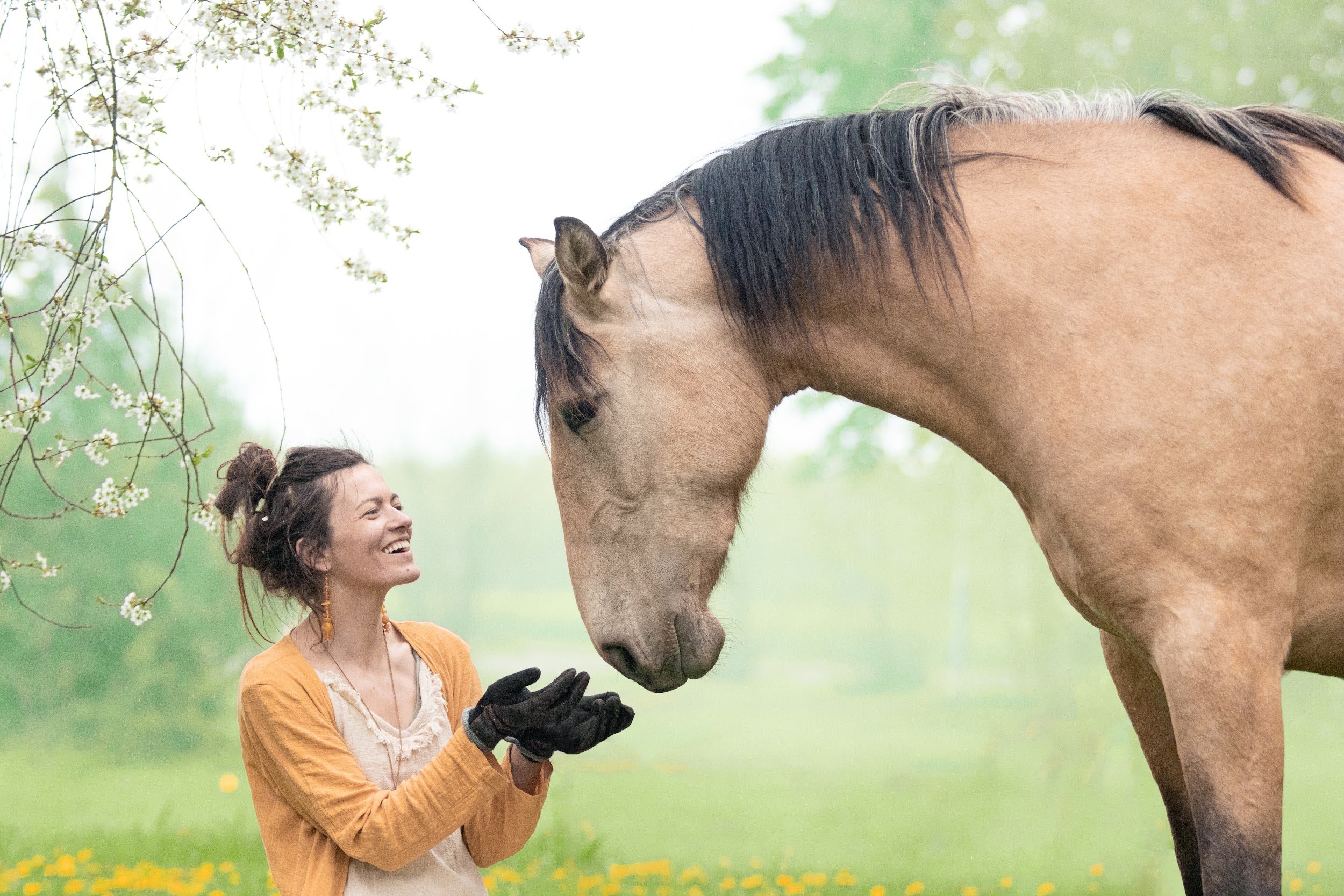
Holistic introduction to horse communication and observation
Weekly additional group guidance sessions (e.g. kiln loading, glazing decisions, workflow)
Not Included
Personal food and groceries, Travel and transport expenses
Optional weekly yoga classes in Bauska with Kris (€10 / 2 hours)
Lessons, Daily Rhythm & Guided Practice
The course unfolds through a gentle yet well-held daily rhythm, balancing focused studio work with spaciousness, rest, and self-directed time. This structure supports depth of learning without pressure, allowing skills and understanding to settle naturally.
Most days include one or two guided studio sessions, which act as anchors rather than fixed “classes.” These moments may involve demonstrations, technical input, or focused exploration, and are complemented by hands-on work, observation, and conversation throughout the day.
Typical guided times include:
Morning session: 10:00–12:00
Afternoon session: 14:00–16:00 (on selected days)
Some mornings are reserved for individual wheel sessions, offering more concentrated, personalised guidance.
Outside of guided hours, participants have generous free time — to continue independent studio practice, rest, walk the countryside, journal, integrate, or connect quietly with others. This balance is intentional: learning deepens when it is not forced.
Regular group Q&A and studio meetings are shaped by the needs of those present. Topics may include studio workflow, design development, glazing questions, kiln use, or the business side of ceramics as well as all practical and philosophical aspects of sustaining a pottery practice — professionally or otherwise.
From Forming to Finishing
As the weeks unfold, the focus gradually shifts from generating forms to completing and refining work. This later phase includes:
Guided glazing and surface exploration
Kiln loading and firing preparation
A raku firing day featuring the traditional Baltic Obvara technique
Support in preparing work for final presentation
Weekends & Community Rhythm
Fridays
Fridays carry a softer, more communal tone. We slow the pace, share a long lunch together, and allow space for conversation and digestion — both literal and creative.Saturdays
Optional, lightly organised excursions may include visits to Rundāle Palace, Bauska town, nearby spas, local restaurants, or nature and cultural outings. Participation is always optional; rest is equally valued.Sundays
Reserved for rest. Studio access remains available 24/7, and some participants choose to work quietly on their own.
Materials & Firing
The following are included in the course fee:
Bisque firing and one full glaze firing per participant to 1260 °C (our 200-liter kiln holds approximately 50 pieces)
Pre-mixed studio glazes
40 kg of stoneware clay
Additional materials (such as porcelain) can be purchased directly from the studio or delivered within 48 hours from a local ceramic supplier.

Wheel lessons
We cover the full wheel-throwing process — from preparing the clay to centring, pulling a cylinder, refining form, and trimming. Attention is given to posture, timing, pressure, and the subtle decisions that shape both form and outcome.
For those with more experience, the work can deepen into more demanding territory: throwing porcelain (my personal focus), teapot making, and complex forms such as spheres or combined shapes. Guidance is always adapted to where each person is in their practice.
The wheel becomes a microcosm of practice itself. How you arrive, how you focus, how you respond to resistance, and how you let go are all reflected in the clay. In this sense, the art of living is quietly present within the act of throwing.

Glaze Alchemy
Gorgeous matte, lava, metallic, natural, and special-effect glazes are at the heart of our studio practice. During the course, we work with both glaze development and a range of application methods, always in relation to form, surface, and firing.
Guidance includes an introduction to glaze theory, health and safety, and practical application techniques such as dipping, pouring, and brushing. We also explore the working properties of the glazes available in the studio — how they move, layer, break, and respond in the kiln.
The focus is on understanding materials well enough to work with confidence, curiosity, and intention.
You’re welcome to explore a selection of our favourite glazes here.
Dine in style
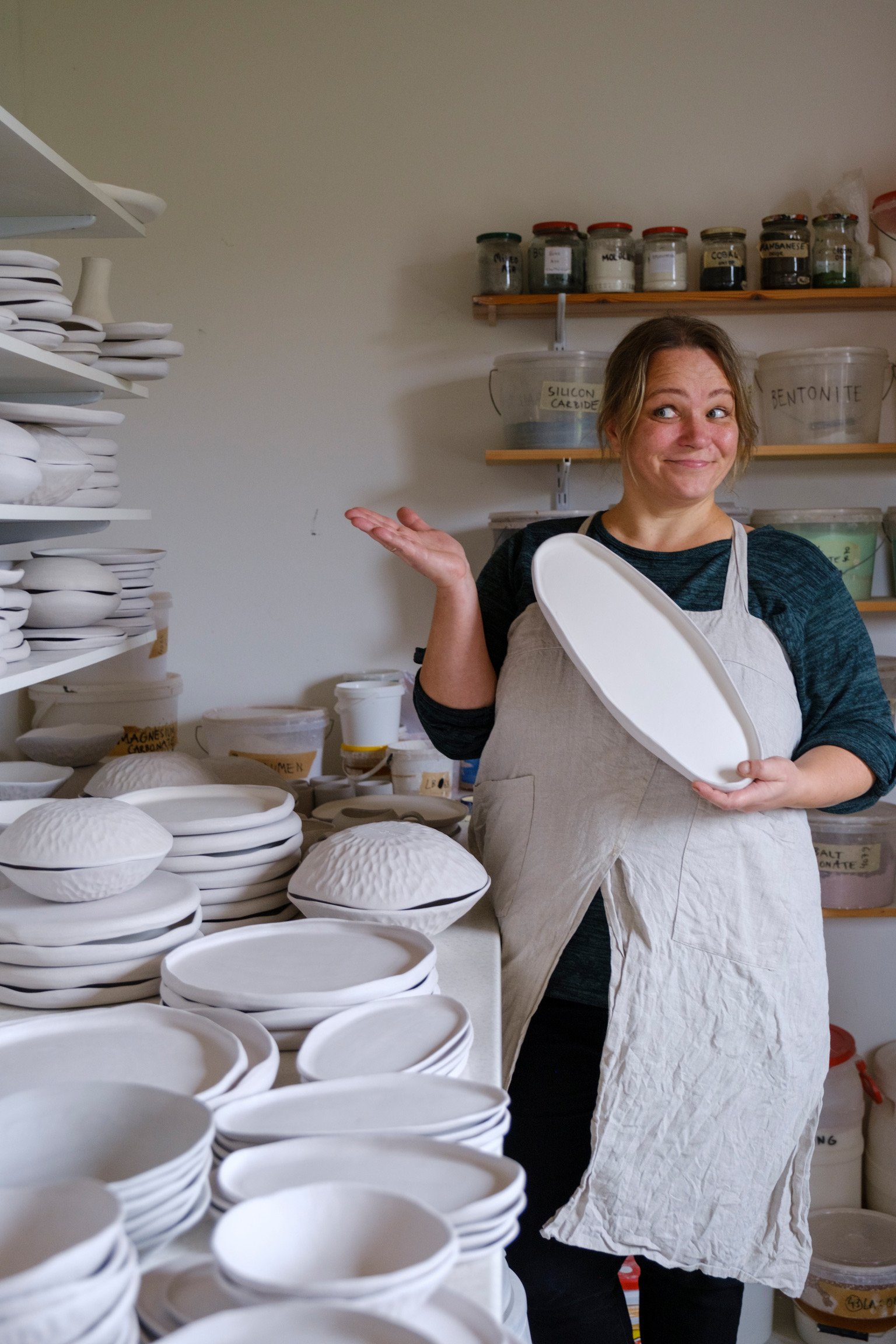
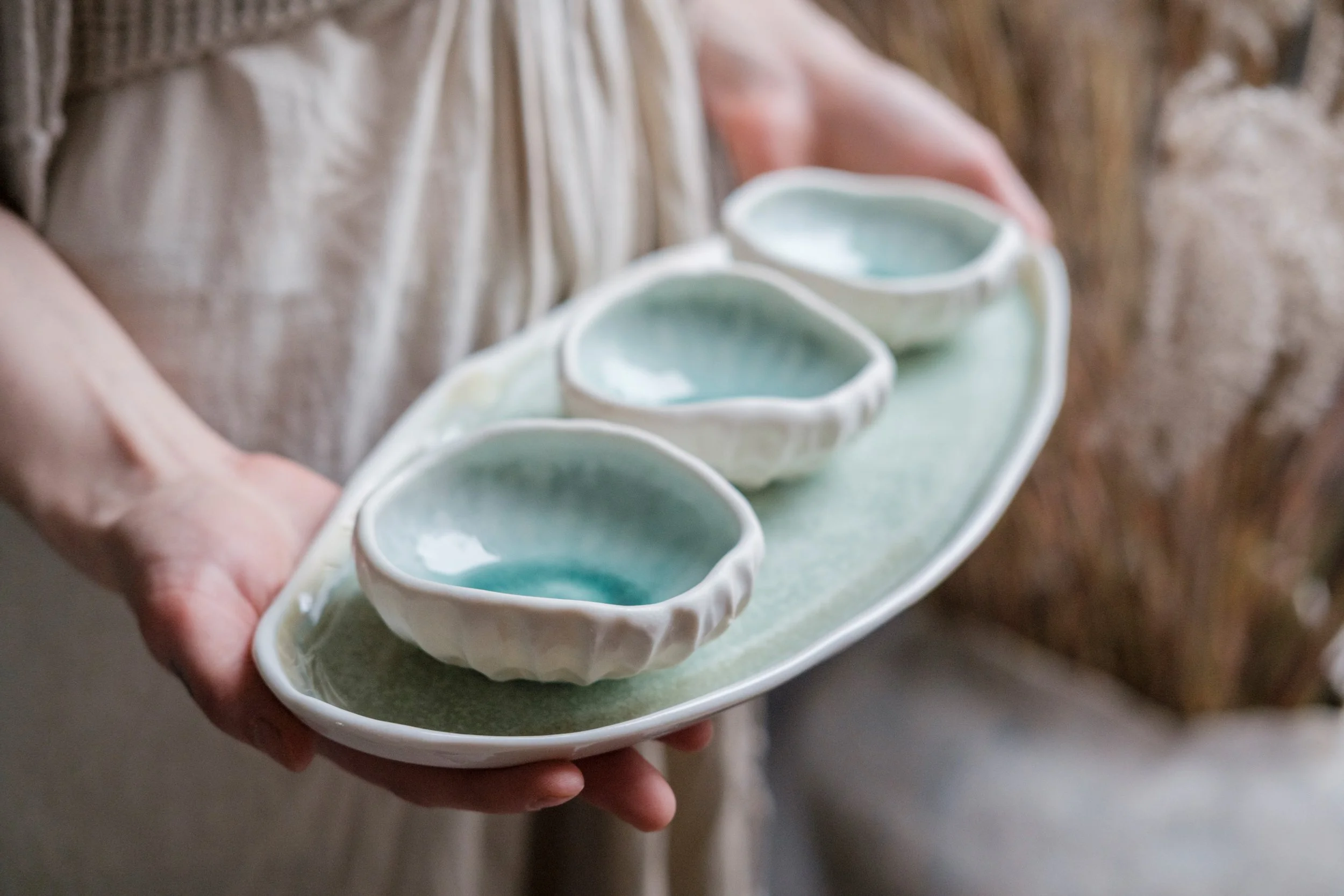
This session focuses on creating a cohesive dinner set using slab-rolling techniques — allowing you to develop professional-looking plates and bowls within a short, focused period of time.
You’re guided through a system that balances precision with ease: how to plan proportions, work efficiently, and maintain consistency. Under this approach, it’s possible to produce a complete, harmonious set in just a few hours.
The method is shaped by long-term repetition. Over the years, we have made thousands of plates and bowls for restaurants around the world, refining each step toward greater efficiency, flow, and grace in the process.
Even for those already familiar with slab-building, this session often unlocks a new level of clarity — shifting how you think about rhythm, organisation, and scale in tableware production.
You’re welcome to explore examples of our dinner sets here.
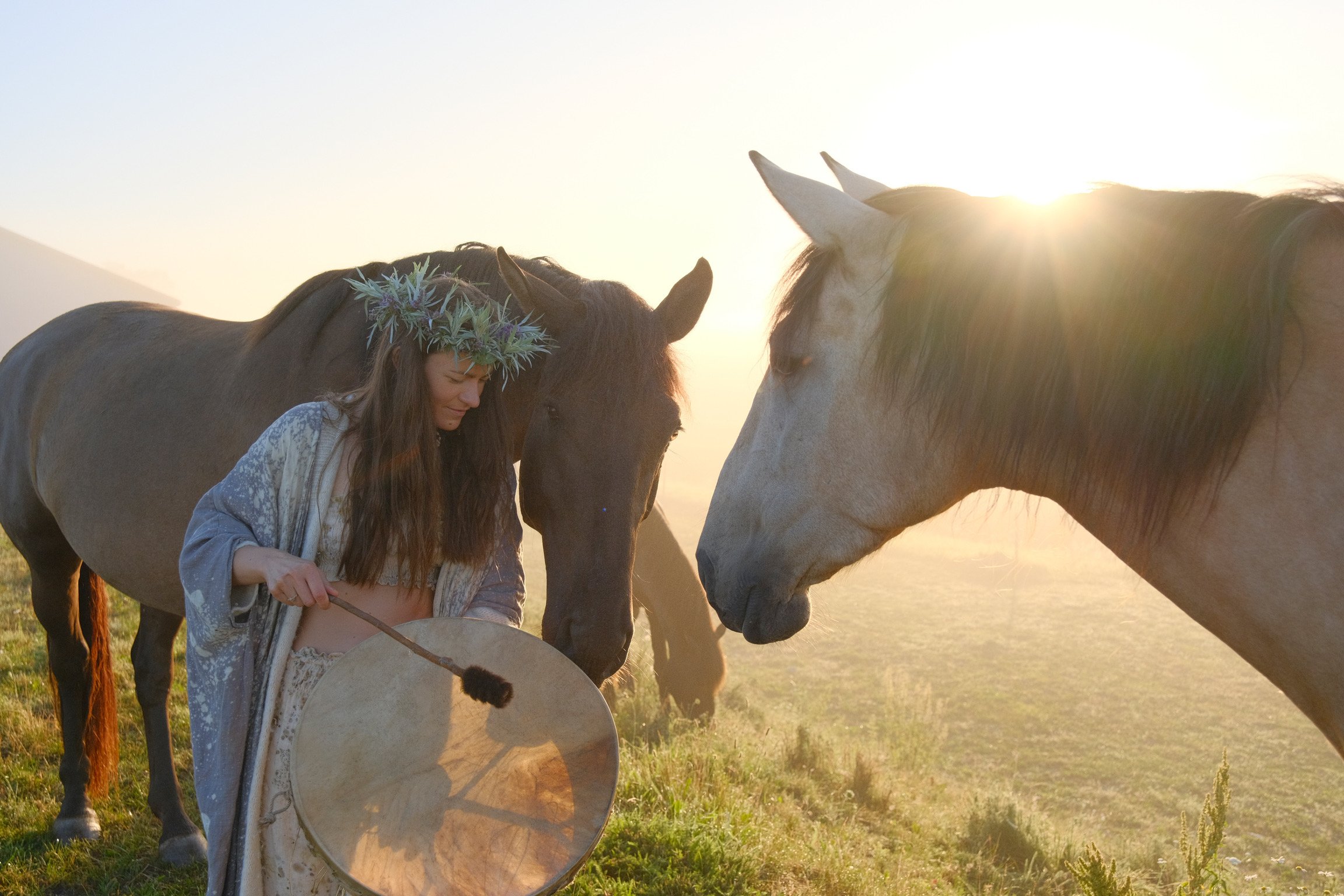
Horse Wisdom
Many people arrive as complete beginners, sometimes even carrying a lingering fear or uncertainty around horses. This session is designed to meet each person exactly where they are.
We begin with a grounded introduction to the principles of horse communication — how horses perceive the world, read body language, and respond to breath, intention, and presence. From there, we move into quiet observation of the herd, followed by simple, respectful communication practices from the ground.
Safety is central. The priority is to create a calm, protected environment for both people and horses. As a sanctuary, this is a place where interspecies harmony and mutual respect guide every interaction.
After a full day in the pottery studio, the horses offer a different kind of attentiveness: mindful movement, regulated breath, and a sense of heart coherence that many find deeply restorative. Any sense of healing arises naturally here — shared, unforced, and reciprocal.
You can read more about our herd and this space here.
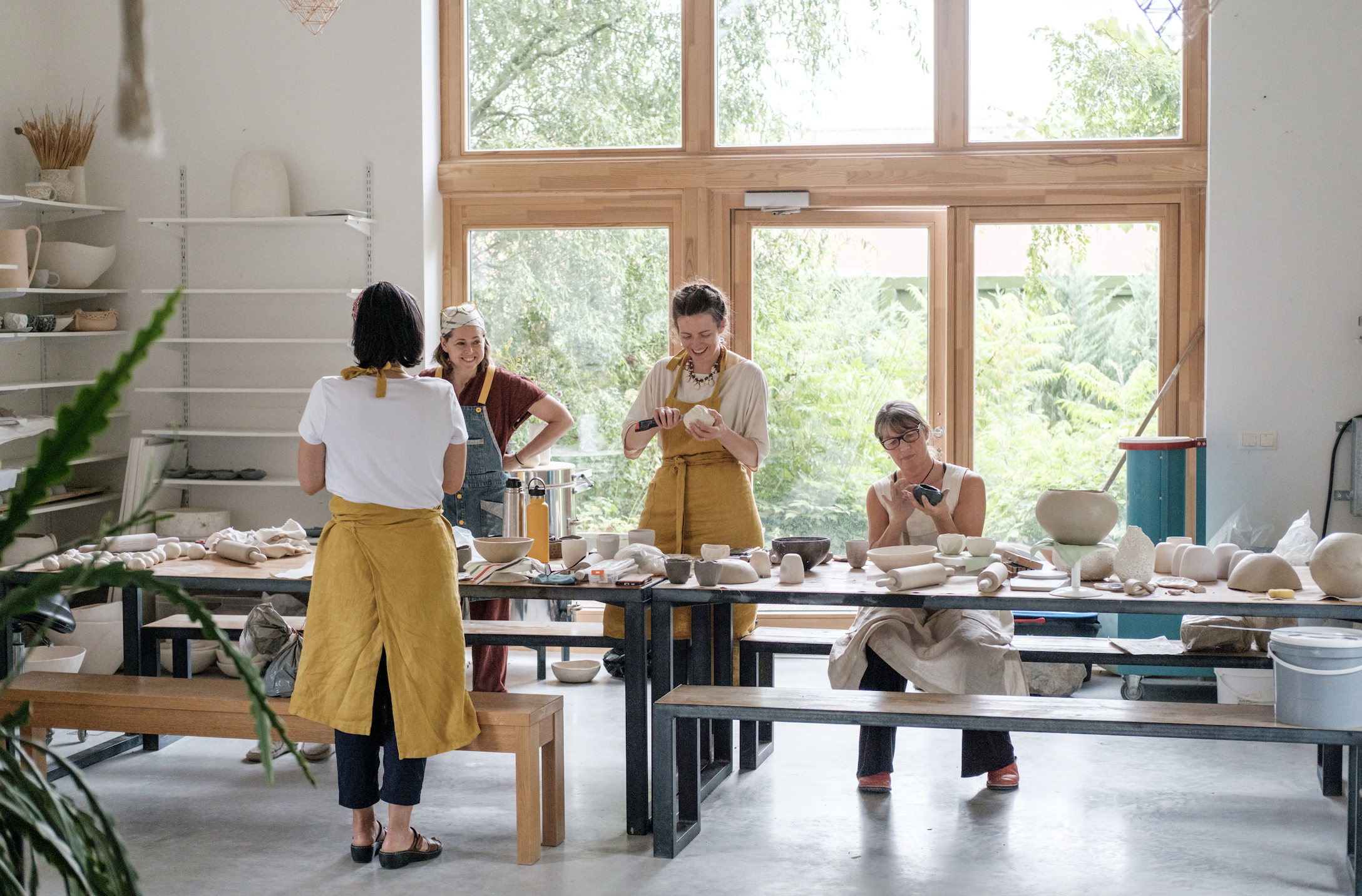
Shared Expectations & Studio Ethos
This program is shaped as a shared working environment rather than a school setting. Clarity around expectations helps ensure that time in the studio remains grounded, respectful, and generative for everyone involved.
Commitment to Practice
Participants are expected to work independently and spend substantial time in the studio developing their own work. Motivation and curiosity matter more than speed or output — practice, repetition, and presence are the foundation of the experience.

Respect for the Space
The studio is both a home and a working environment. Care for the space — physical, emotional, and energetic — is essential. A calm, attentive atmosphere supports focus, creativity, and the ability to work well over long periods of time.
Clear & Considerate Communication
Good communication allows the studio to function smoothly. Transparency, directness, and mutual respect are valued, especially when working and living in close proximity.
Guidance & Exchange
Guidance is offered generously and with care, while participants are invited to take responsibility for how they receive and integrate it. Alignment is established through the information shared on this page and through the application process, ensuring that expectations are clear on both sides.
Application Process
To apply, please send a short letter to laimaceramics@gmail.com
In your message, please include:
a brief outline of your experience with ceramics
your motivation for joining this course
what you hope to explore or develop during your time here
Once your application has been reviewed and accepted, you’ll be invited to reserve your place via the listing below by paying the deposit.
After registration, you’ll be added to a private WhatsApp group where we share arrival details and practical information, and where you can connect with the rest of the group ahead of the course.
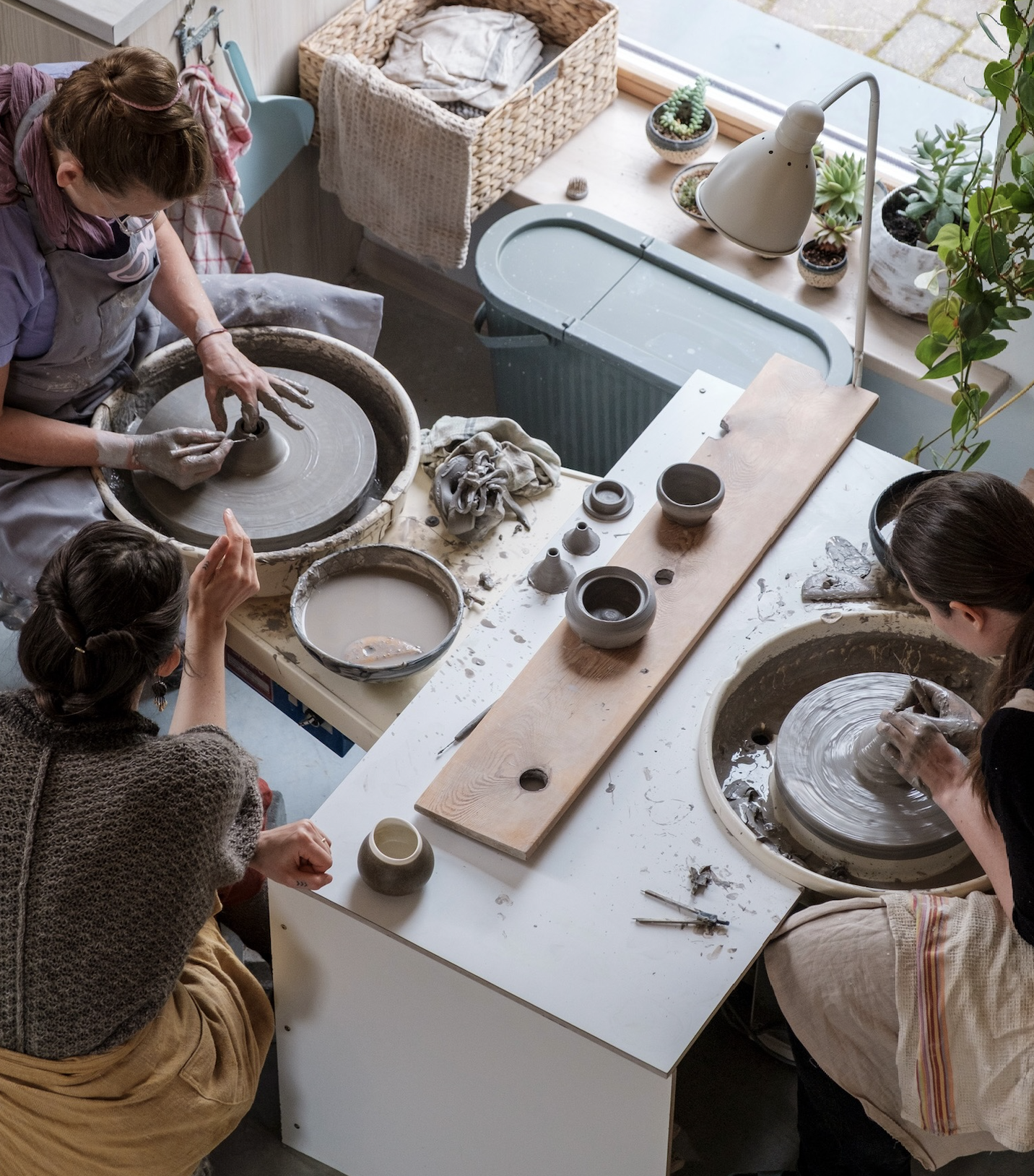
TestimoniALS from previous participants
-
![A man and woman making pottery in a studio. The man is shaping a large clay piece on a turntable, while the woman observes, sitting at a wooden table with pottery tools and finished pieces. Shelves with bowls and pottery are visible in the background.]()
Alex
UK, 2024 (2 week residency + individual lessons)
“I arrived at LaimaCeramics unaware of what awesome time lay ahead. From minute one I was welcomed into the fold and inducted well.
The sessions were delivered really well and my skills were greatly improved by Laima's and Oksana's training.
Punctuated with moments of hilarity, the setting is beautiful and I had a chance to unwind in the country side when not potting. I strongly recommend this trip to anyone who enjoys the craft. Thanks again team.”
-
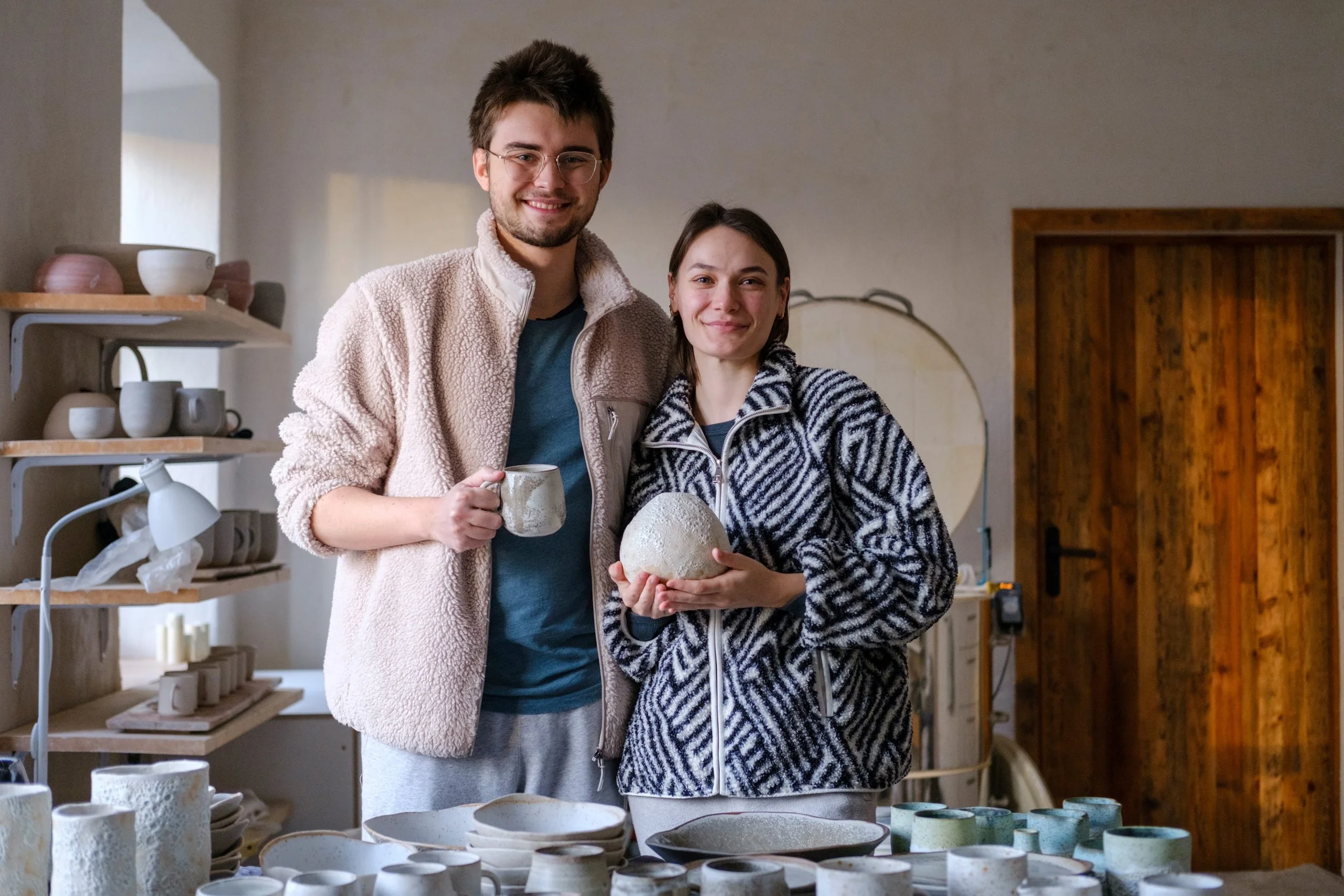
![A young man and woman in a pottery studio, smiling and holding handmade ceramics, with shelves of pottery behind them and a wooden door in the background.]()
Arthur & Katja
Custom made 4-week course, January 2024
“We had a wonderful time at Laima's. Early January, we arrived in winter wonderland, sun reflecting off the pristine white snow. We left a month later, as an early spring began to break out, bidding farewell to our horse friends as they trudged serenely through the fresh mud. In between, we found out a great deal about clay, throwing, glazes, and overcoming frustration.
Novices on arrival, we had everything to learn. And learn we did, thanks to Laima's lessons and her wise stewardship of our journey to a full dinnerware set. While we were gradually learning the complex skill of throwing on the wheel, Laima made sure that our cupboard filled up thanks to a variety of techniques, including slab-rolling and hand-building.
We got the hang of throwing after about a week and a half, and even went as far as making teapots and throwing porcelain.
By the end, we had 118 pieces, including some made-to-order for our friends and relatives. Whenever someone said, "we could do with a..." or "I just broke my...", we could fly to the rescue.
It has been strange coming back to a world without our own workshop and losing our superpower.
Thank you once again to Laima, Krisjanis and Oksana, we hope to be back one day.”
-
![Two women smiling, each holding a rolling pin, standing indoors with plants and a window in the background.]()
ZOE MAIN
USA, 2022 (Internship)
“I had the time of my life at Laima Ceramics! This was one of the greatest opportunities I’ve ever had the privilege to partake in. Laima’s studio is the perfect balance of beauty and functionality, which makes sense considering the beautiful pottery she makes.
Not only did I get to learn her methods, but also she championed me to find my own! I learned all kinds of things from production pottery to glaze theories, and everything in between! She fosters creativity and is generous in sharing her extensive knowledge. She encouraged myself and the others in the studio to read her glorious little library of books, which broadened my horizons even more! Laima empowers you to dig deep within yourself and pull inspiration from the world around you and utilize the creativity that you may not even know you had within you! Her home and family farm are absolutely stunning and are the perfect place to go if you want to dive into the world of ceramics and get renewed in the beauty that surrounds you!
I also have to shout out Oksana, who is Laima’ AMAZING assistant! The hard work and humor she brings to the studio is inspiring and lifts everyone around her.
Latvia quickly became one of my favorite places I’ve ever visited! (And I’ve visited A LOT) Now, I don’t know if it’s because of how beautiful it is as a country or if I just adored Laima, her family and Oksana… or if it was the potato pancakes! Maybe a combination of all of these!
All and all, I left a better potter and human, I owe that to Laima.”
-
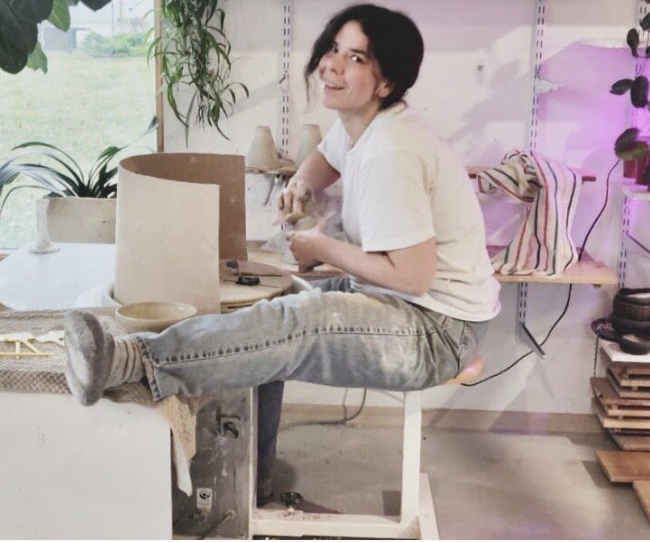
![Woman shaping a clay bowl on a pottery wheel in a ceramics studio.]()
Anna
Poland, 2023 (1 week course)
“I attended Laima’s one-week pottery course in September 2023, and I can say without exaggeration that it was life-changing for me. I knew that pottery is quite a complicated thing in comparison to other hobbies because it is expensive, very time-consuming, and requires good skills and special tools.
Being there was like living the life of my dreams for a week. The place is marvellous - there are no people around for about 3.5 km, just deer, horses, cats, and dogs. The huge studio is full of beautiful pieces - I’ve spent hours just sitting there and staring at them.
The course still seems to be a pure miracle for me. No one believed that a complete beginner like me could make a beautiful teapot on the 3rd day of the course (because it was structured so cleverly and carefully!) Laima said true mastery requires time, but she can teach everyone how to throw on the wheel in one week to inspire further development. And she did so with her kind and bright smile, guessing and showing me techniques before I knew what I needed. It’s your calling to be this rare teacher remembered for a lifetime.
During the course, I made my ceremonial tea set, set of sgraffito porcelain plates and amazing Baltik Raku pieces. All the pieces were safely packed, sent, and arrived at me in a month. “
-
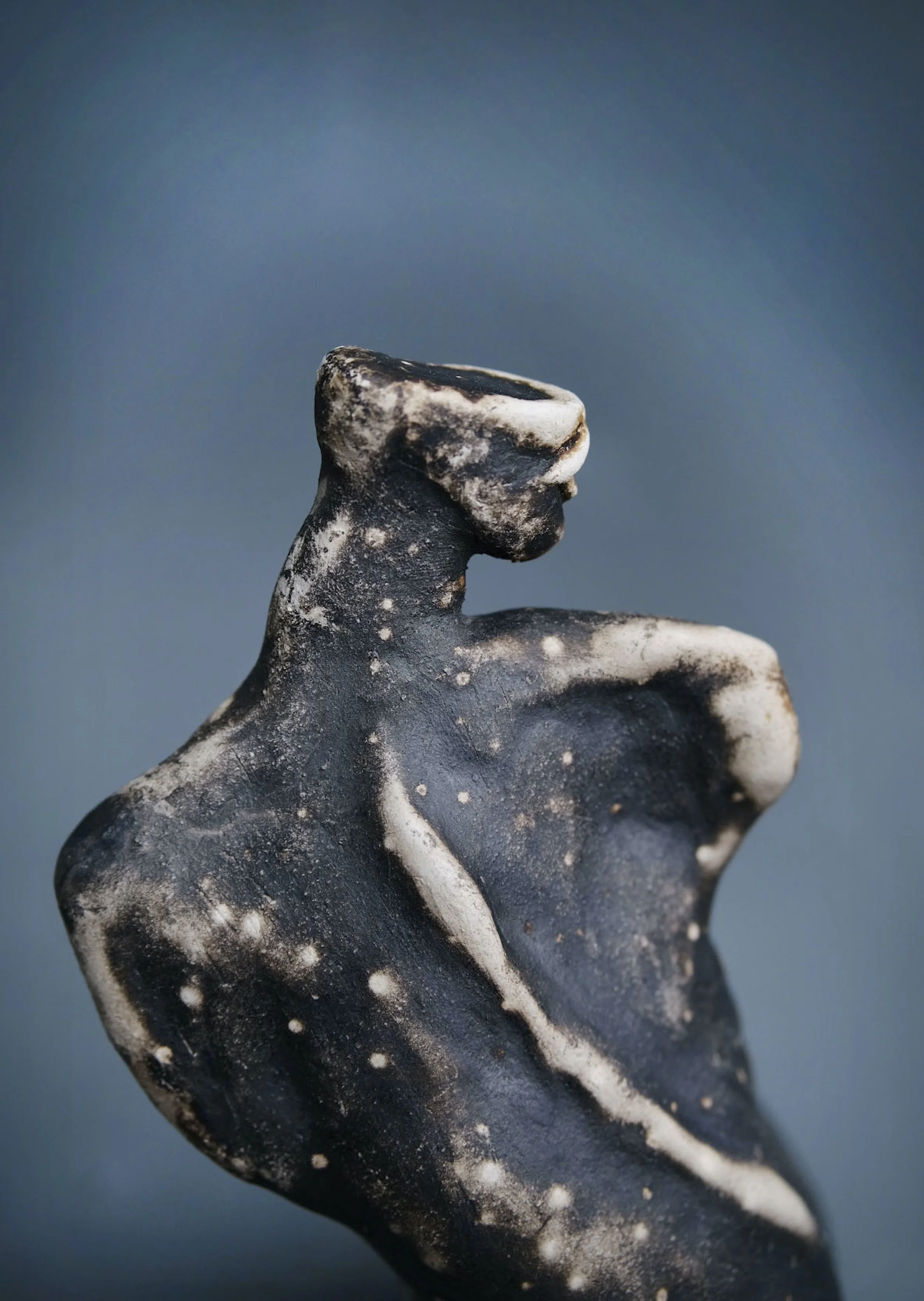
![Close-up of an abstract sculpture of a human figure with a dark, speckled surface and white highlights, set against a gray background.]()
Aino
Finland, 2023 (Apprenticeship course)
“My course with Laima was something that changed my future as a human and my path in pottery forever.
Laima is really unique person in this kind of world we live nowadays. She is open and understanding, but really what stroke to me was her way of dealing group dynamic, how sacred it was to her to keep the group dynamic working even we had our up and downs, she was supporting us all the way trough.
And should not forget the importance of Oksana in studio - her presence shines the day and really we all felt like family in there together.
The most important lesson from Laima was her encouragement for me to go forward as an artist in ceramics, to believe in my talent and also to trust in myself. And that was exactly what I needed from this month.
I found life-long friends from different ages with same passion, sharing this magical one month together.
This course is so much more than just pottery learning. If you get the chance to learn from her - jump for the chance! “
-
![A woman holding two large white ceramic vases, one on each shoulder, smiling in a pottery studio.]()
FLORENCE WILLIAMS
UK, 2021 (Internship)
”My time spent with Laima in the depths of Latvian wintertime solidified and developed my understanding, appreciation, and absorption with clay. Not only was the experience deeply grounding in that it reinforced my previously held belief that I wanted to pursue ceramics through and beyond the treatment of it as purely a hobby, but it also expanded my ideas regarding what I myself may be capable of through utilisation of it as an endlessly practical, functional and beautiful material.
The experience in the studio I can truly say I found to be transformational. Not only for the exposure to so many different kinds of learning - from Laima’s way with horses, to the endurance of the cold, to dealing with breakages and disappointment in the studio - but also for the time it allowed me to think, to be quiet, to indulge in introspection and to consider where I wanted my priorities to lie post-apprenticeship. This allowance of time to think is a part of the role which I feel I personally may have somewhat undervalued in my past experiences of learning a new skill. Yet, having a space to breathe, to be alone, to think about one’s own motivation and passion, is a greatly underrated aspect of the apprenticeship that I am - three months post-leaving - still benefiting from.
I am endlessly grateful to Laima - as well as Kristine, Dzera, Minne and Dzeronimo - for providing a space to learn, grow, connect, and explore during such an unprecedented period of time. I very much hope to return to the studio to swim in that feeling of peaceful productivity once again.”
-
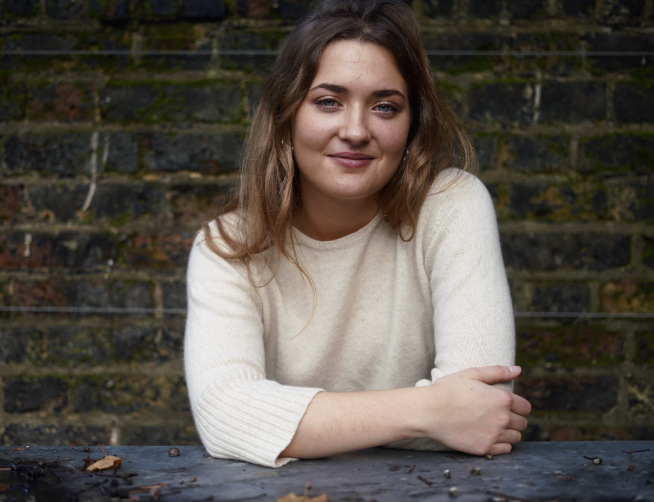
![Young woman with shoulder-length brown hair and a light sweater sitting at a table outdoors in front of a brick wall.]()
esther palmer
UK, 2020 (Artist Residency)
“The studio is a brilliant environment for working, equipped with everything you might need to explore new ideas. It invited creative thinking and productivity, but also peace, and wellness, with a constant stream of herbal tea to take you through the day.
It was a hugely immersive experience being in the middle of nowhere, having no distraction, and therefore the ability to truly relax. The studio backs on to Laima’s beautiful orchard and garden, where she grows her own veg and keeps her very sweet goats. It was a lovely space to take a walk and breaks throughout the day. There is also a little pond that I would swim in in the mornings, and after Sauna on Sundays, which were probably my favourite thing of all.
I feel so happy to made a friend out of Laima, she was kind and open and generous with her time and experience. We had loads of lovely chats about the lessons of pottery, and her animals and life in general. She has carved out a true home for herself, one which I would love to go back one day!”
https://www.estherpalmerceramics.co.uk
-
![A woman in a sleeveless top and apron gleefully shapes a small gray ceramic vase on a pottery wheel in a ceramics studio.]()
EVA GILDER HODGSON
UK, 2020 (Artist Residency)
“Experiencing Laima's world was a beautiful experience. The communal studio created a creative environment which was nurturing and explorative.
My understanding of clay and appreciation of slow making was enriched, as was my mindfulness as I slowed down in the calming landscape. Laima's world is full of passions and connections with nature, and I found these influences reflected in the making process and outcomes.
Her home was shared open heartedly, and her generosity and friendship will be remembered very fondly.”
-
![Close-up of a person using a pizza cutter on a pizza on a round tray, with a patterned tablecloth underneath.]()
MAY ANGELINE
UK, 2022 (Internship)
“I spent a few months at Laima’s studio in a truly immersive experience. The week days were focused on producing a range of designs, which exposed me to new techniques and skills as well as an understanding of the discipline of production pottery.
Laima would often work alongside, openly talking about her approach and philosophies and inviting observation of her making. She also gave some insights into the commercial aspects of running her own business and successful studio. I really appreciated Laima’s encouragement for exploration and willingness to share her experiences.
I had the freedom to work on my own pieces and creative practice. Having a beautiful and well-equipped studio at my doorstep, and engaging in a little community of avid creatives in the middle of the Latvian countryside - it was a unique microcosm in which I could indulge in my love for ceramics. I gained a lot from my time there and I’m very grateful that this opportunity came my way.”
-
![A woman sitting on a pottery wheel, working on clay in a pottery studio, smiling at the camera.]()
ELIZA KIMBERLY
USA, 2020 (Internship)
“Laima allowed me to explore materials without barriers and create without rules. Even when she doubted my loud and impractical ideas, she never scolded or discouraged them, but instead was always there to step in with support if you asked. Always concerned with giving us our own time to build our craft, Laima’s scheduled workday was laid back yet extremely productive.
She showed me a path forward in ceramics, one that upholds creative authenticity yet sustains as a viable lifetime career.
Having done ceramics for just a year by the time I came to my apprenticeship, I was so thrilled with all of the resources Laima’s studio had to offer.
I had never experienced or heard of space with such an expansive offering of different clays, generous workspaces, an extremely well-stocked glaze room, the ability to fire pieces in multiple environments, and true freedom to explore. A ceramicists dream.
I am still missing the farm and studio— dinners with the crew, movie nights and karaoke singalongs, always searching for a wandering cat, late nights trying and failing and trying again in the studio, and the sunlight streaming in.
Aside from ceramics, our time was filled with getting to know Latvia. It makes me laugh to think about strolling through the countryside and town with our wild pack of dog, cat, horse, and human. I was struck by the kindness of Laima’s family who involved the apprentices in countless family activities and supported me through many stressful times, becoming a lifeline while navigating Covid-19 so far from home. I will never forget my experience, Laima, the people and animals I loved, and I can say with confidence I will return one day with joy and excitement.”
-
![A woman sitting at a white table near a window, decorating a cake with white frosting, with plants and kitchen items around.]()
MARIS BORN
ESTONIA, 2018 (Internship)
“I had this amazing opportunity to stay with Laima for 3 months in the wintertime. On the very first day, I got to see how friendly and open Latvians are with foreigners. I arrived on Sunday and straight away Laima hosted me with herbal tea and introduced me to her friends and the day ended in the sauna. Every Sunday is a sauna day!
Laima was very easy to communicate with. Every workday we went to the studio and she gave me some duties to do. At the same time, she was working on her own things next to me, so I had a chance to learn from her all the time. Laima was very trusting in me and let me work on the tasks however much time I needed. She gave me a lot of freedom to do my own ceramics also.
Laima has so much knowledge of ceramics and different techniques. But still, every day she had a lot of passion to learn more and more new ways how to express herself through ceramics. That was impressive and made me push myself even more, to continue my journey on this ceramic field.”
-
![Stacked white bowls with black interior, four on each side, containing different liquids: on the left, a caramel-colored liquid; on the right, a dark black liquid with bubbles.]()
SILVIA CHITI
ITALY, 2019 (Internship)
“I'm very glad this opportunity came through. I started working with ceramic two years before going to Laima's, and I was already in love with it...but once there it was better than I could ever imagine: a fantastic studio equipped with all the things a ceramist can dream of and plenty of different clays, from local one to stoneware and also English porcelain!
And last but not least, Laima with her experience and her discreet presence was always creating a relaxing environment.
I gained a lot of experience and self-confidence in the making process: accomplishing every working day different tasks that Laima was giving to me and developing my skills working with new materials and trying new shapes.
I felt I always had the freedom to choose what to explore and how to develop my ideas. And whenever doubts came over, Laima was there with helpful comments.
The place is immerse in the countryside, I sometimes engaged myself with Laima's horses, with her dog Džera and with her garden too...or sometimes just listening to whistling birds or powerful tractors and relaxing your eyes contemplating nature.”
-
![A woman with glasses and a casual outfit smiling in a pottery studio, with shelves of plates and bowls behind her and pottery pieces on a table in front of her.]()
KRISTA OZOLA
LATVIA / UK, 2019 (Internship)
"My internship was two beautiful months of learning, exploring and witnessing artistry and craftsmanship.
Starting with zero experience in ceramics, I feel I grew to have a solid foundation and understanding of it. Laima gave a relaxed and supportive environment to freely explore my own ideas and style while I also really enjoyed being involved in the process of helping her with the studio tasks and learning the different techniques and stages of the making process through the practice and observation.
Laima’s place is surrounded by countryside with calm and peaceful environment. so when in need of a break from the studio, there’s a lush garden to inspire from or the presence of Laima’s beautiful horses. I am ever so grateful for this experience and opportunity!”
-
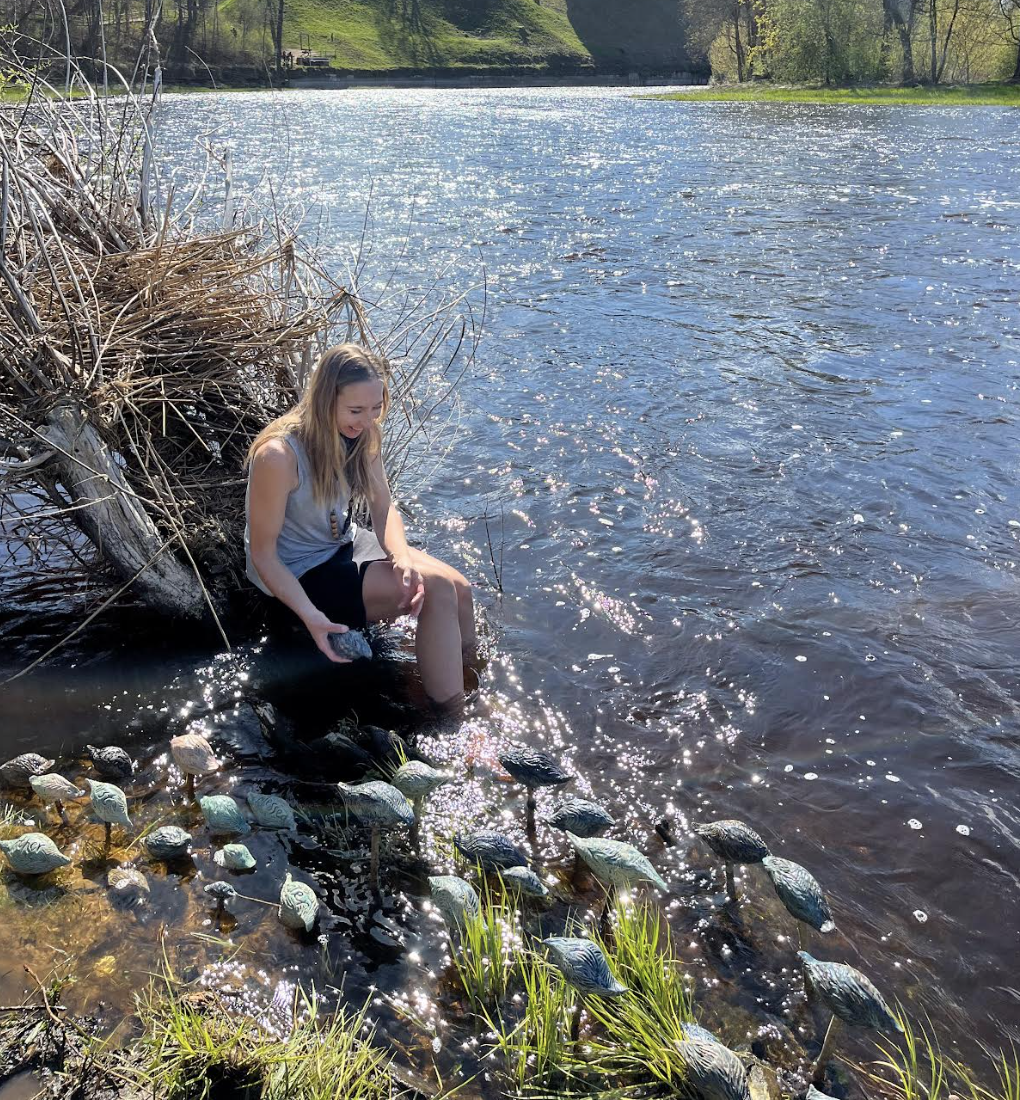
![A woman sitting on a rock at the edge of a river, surrounded by ducks and dry reeds, on a sunny day with clear water and green trees in the background.]()
Niusia
2023, Poland (Artist Residency)
“The decision to undergo this ceramic residency at Laima Ceramics was informed by my love of the natural world, and being allowed the space to learn from Laima, the landscape and fellow apprentices, while having access to a fully operational studio was enjoyable, challenging and rewarding.
It was a pleasure to be surrounded and informed by Laima's similar ethos and appreciation of nature and to have shaped clay into objects that formed a series of land art installations around the Latvian countryside.
To be offered a space to be creative feels more important now more than ever.”
-
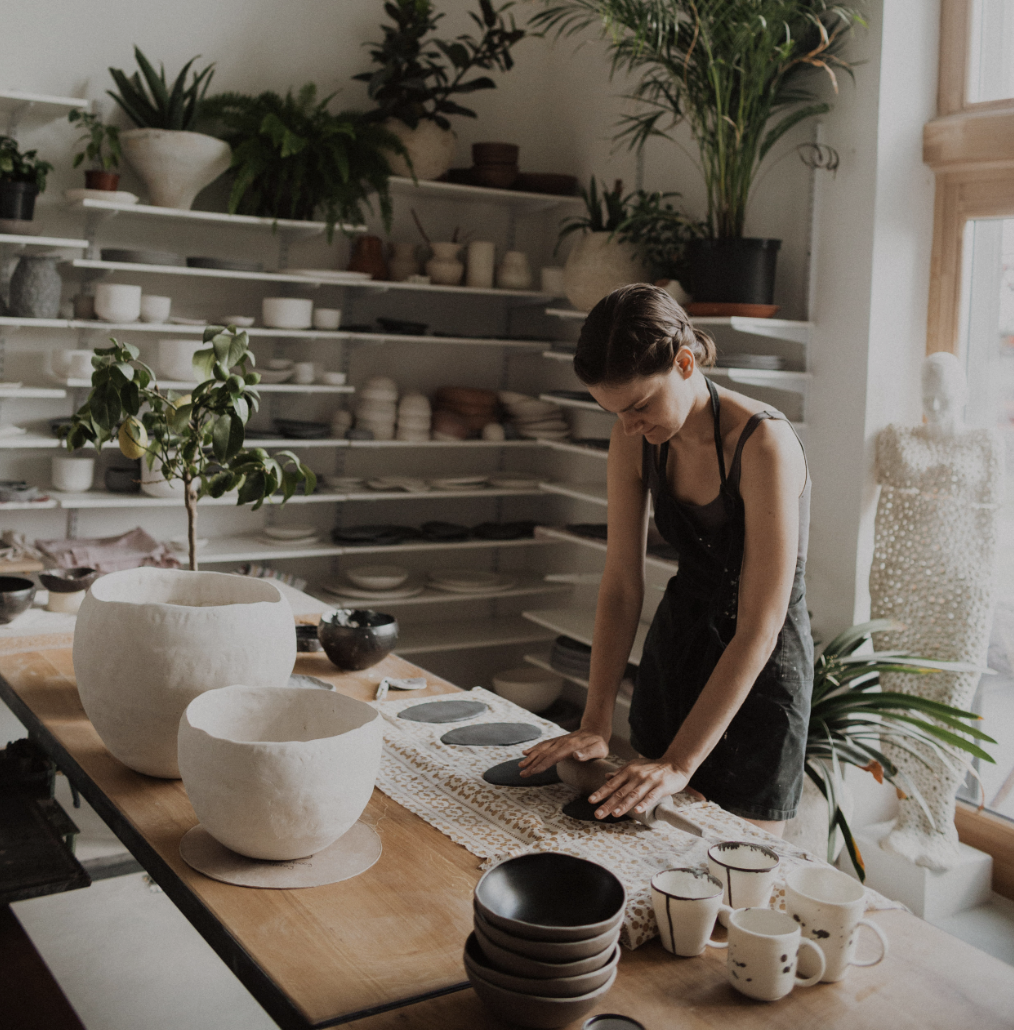
![A woman in a black apron is working on a pottery project at a wooden table, surrounded by completed ceramic bowls and vases, in a well-lit studio with shelves filled with various pottery items and plants.]()
LAURA ELIZABETH GISLER
USA, 2019 (Internship)
“My time at Laima’s expanded my skills and the breadth of my practice extensively. Laima is incredibly generous with her vast and diverse knowledge of ceramics - from different bodies and compositions to glaze experiments to firing techniques and art/craft as activism philosophies - she was just the kind of enthusiastic master you hope to practice with, always up to let me try and wise beyond her years. In particular, I wanted to build out my wheel practice, and during my time as an apprentice she gave me opportunity, guidance, and support during the patience-building exercises.
During the days, I was involved in making her designs and got to run or participate in various inter-workings of her highly-functional and productive studio.
We also ate vegan, tried living zero waste, practiced yoga, and observed a Sunday sauna ritual throughout the summer and fall. As with all practices and collaborations, I learned so much about myself, my environment (including the Latvian countryside), and the wonderful artists, family, friends who passed through the studio during my time. It was a challenging, exploratory, deep learning experience for which I am extremely grateful.”
-
![A man wearing a knit hat and a black respirator mask, giving a thumbs-up and winking.]()
Thomas SCHUTE
Germany, 2020 (Internship)
“Laima introduced me to the craft in a gently-paced and considerate way. She was always available for questions and I learned a lot, as would be the case anyway for a beginner; with her guidance however I had somebody to accompany me throughout different stages of my learning process and help me along through roadblocks without interrupting my own explorations.
I had a wonderful experience at the studio and Laima was very generous with her time.
Unfortunately I had to cut my stay short due to Corona, but Laima offered to store my unfinished works for me so I could finish them at a later time.
When things don’t go as planned it’s easy to reach a common understanding with Laima.
I am very grateful to her. She is a very dedicated, committed and detailed potter as well as wonderful teacher, mentor and just a lovely person.
Her demands in terms of work hours and your contribution to the studio as an intern are really fair.
If you dedicate your time and manage wisely, you will get a lot out of your stay at her studio.”
-
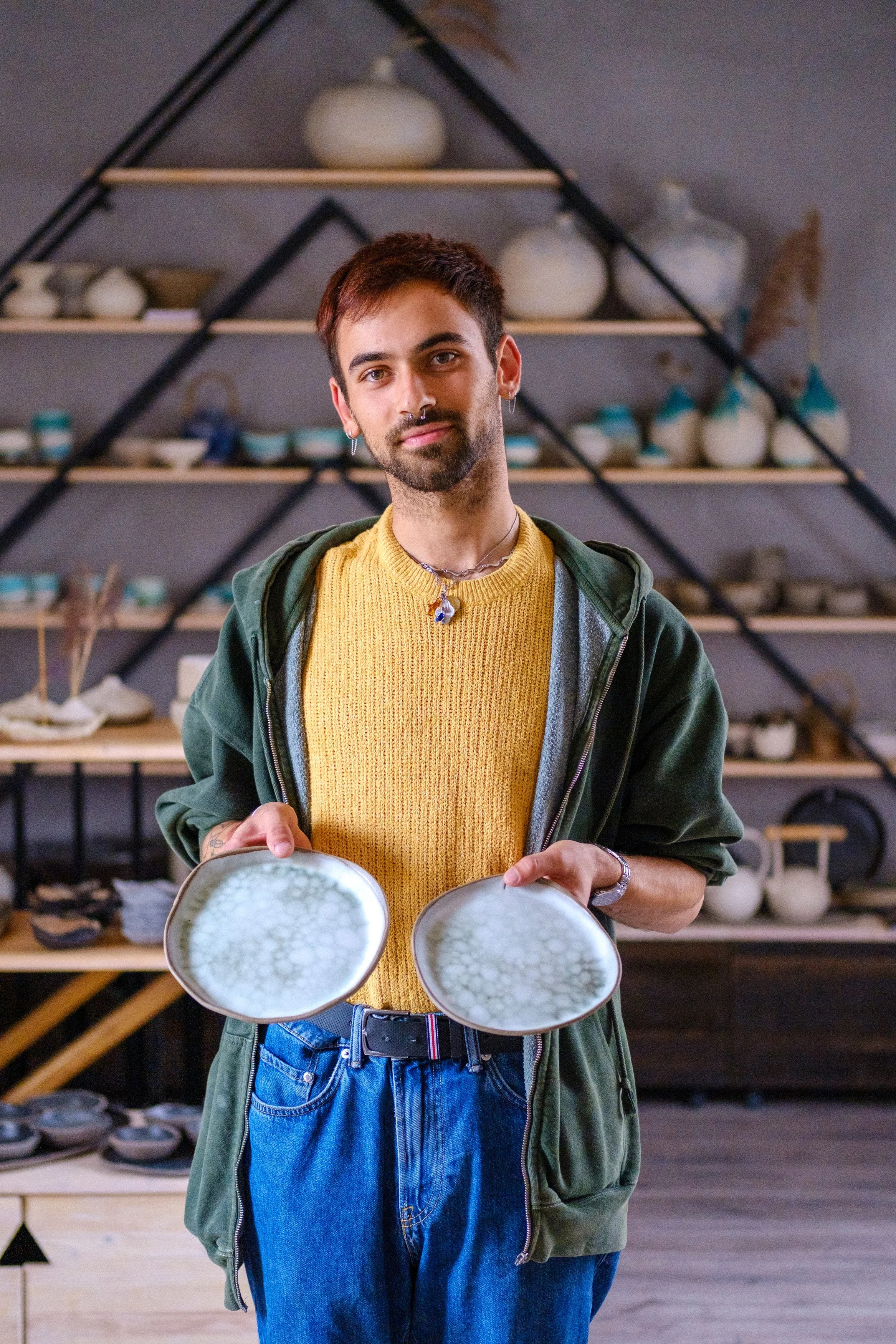
![A person with short brown hair and earrings holding two ceramic plates in a pottery studio with shelves of pottery behind them.]()
Andrew Maher
Ireland, 2023 (Apprenticeship course)
“The two months I was staying at Laima Ceramics was one of the best experiences I’ve had.
The sense of family is so welcoming and the learning opportunities to excel in your skill is brought out there.
One of the most peaceful and beautiful places I’ve been.”
-
![Decorative ceramic tableware and objects on a textured tablecloth, with a small vase holding dried flowers, lit candles, and a teapot visible in the background.]()
Maud
Apprenticeship course October 2023
“The 4 weeks at Laima Ceramics honestly changed my life. Laima’s place is truly inspirational, embodying how dreams can be turned into reality.
The studio is absolutely gorgeous and a bright space to work and be in. Then you have the ever lovely Oksana, a sunshine in the room with her warm personality and contagious laughter. The Laima family includes also Dzera, the sweet sweet dog, cats and horses - who teach many lessons of their own to the ones willing to listen.
At times I felt frustrated that I did not receive more guidance, but later I learned this to be a great gift. The gift of allowing us to explore freely and make mistakes!
Thank you Laima. Not just for the extensive knowledge you shared and the confidence I gained with clay but also for the magic that happens when beautiful people come together and connect. “
-
![Set of handmade ceramic cups and bowls on a table.]()
Monika
Apprenticeship course, October 2023
"My time as an apprentice with Laima was one of the more impactful things I have done in my life.
The farm is a truly unique place with great energy. I grew as a potter, both technically and creatively.
The friends and connections I made were very deep as well. At times things were challenging, making deadlines, learning new techniques, navigating group dynamics and there were mice!
But through our journey Laima was a solid mentor and gave us a great place to express ourselves.
Latvia is a really special country, and it was a great way to learn about and experience the culture.
On many levels I recommend the experience. It's important to be self motivated and set the right expectations, and if you can do that you'll have a great time."









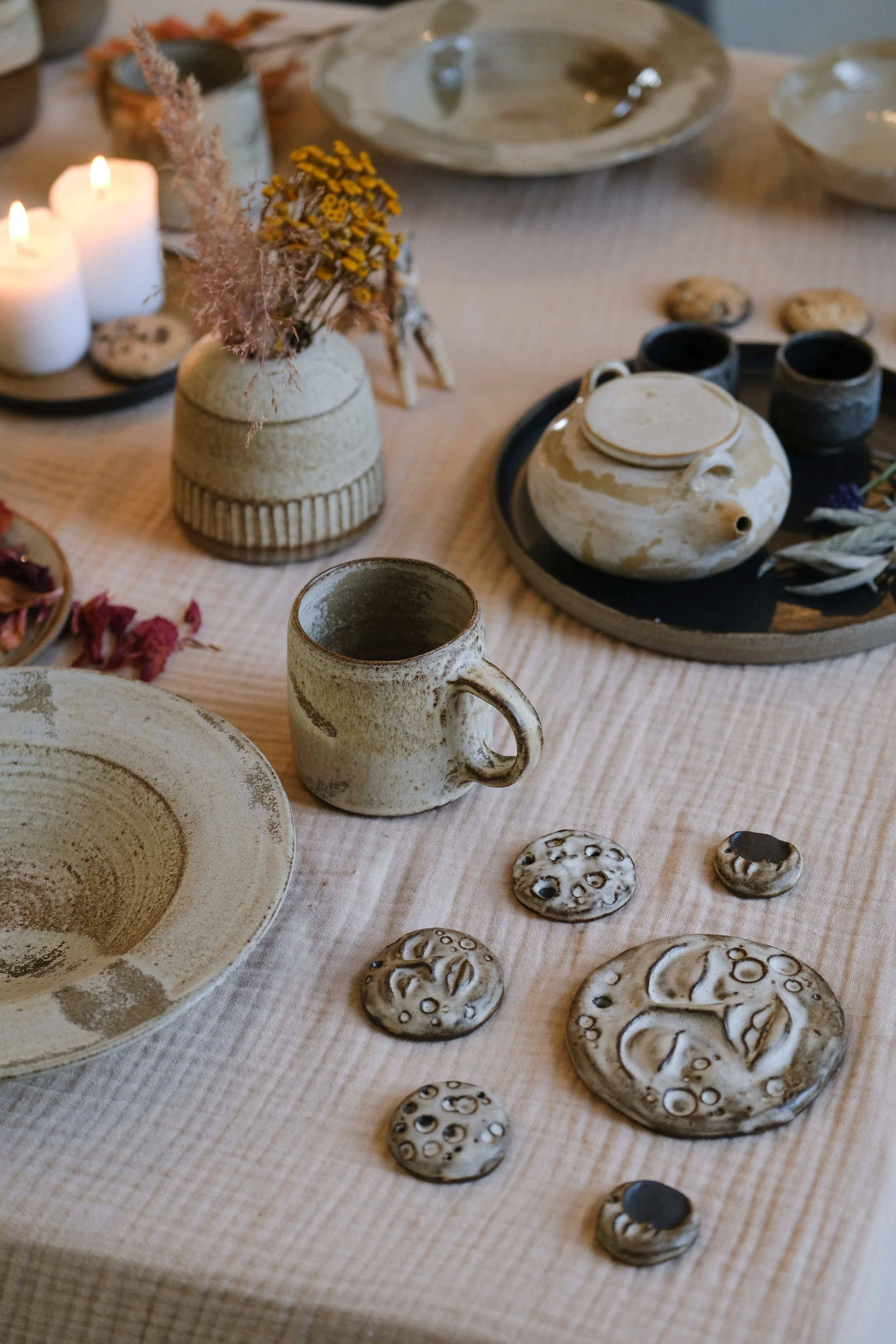

A private four-day ceramic experience designed around one participant — your own pace, interests and level.
The programme combines wheel throwing, hand-building and slab rolling. The programme is suitable for complete beginners as well as experienced potters. You don’t need to arrive with a specific project in mind — we can discover what you would like to make together and adapt the four days accordingly.
Bringing someone with you
Although the immersion is booked per person, you are welcome to come with a partner, friend or family member and share the experience. The programme can be adapted to two participants, even if you have different levels of pottery experience.
Our guest room has a 140 cm double bed, and we can also add an extra bed if you are travelling with a child or need separate sleeping arrangements.
The listed price is for one participant. If two people would like to take part in the ceramic immersion, the same price applies per person.
THE FOUR DAYS
The programme below is a basic proposed structure for beginners. Because this is a private immersion, the content can be adapted considerably to your experience and interests. Experienced potters may use the same time for more advanced wheel work, porcelain, teapots, lidded vessels, more complex forms or a specific project.
DAY 1 — Arrive, Discover & Make
11:00 — Arrival & Introduction
We begin at 11:00 with a tour of Laima Ceramics and the surrounding farm.
You’ll get to know the studio, the people who work here and the animals who are part of everyday life — including our horses, ducks, cats and dog.
We’ll introduce you to the studio, our clays and equipment, and give you an overview of the ceramic process, from preparing clay and making forms through to glazing and firing.
Afternoon — Hand-building
After the introduction, we get straight into making.
You’ll explore hand-building techniques and create your first pieces, while getting a feel for the clay and the different possibilities of working with it.
Depending on your experience, this can range from basic construction techniques to more considered or sculptural forms.
DAY 2 — Wheel Throwing
Morning — Demonstration & Practice
For beginners, we begin with a one-hour wheel-throwing demonstration, covering the fundamentals of preparing clay, centring, opening, pulling and shaping.
This is followed by one hour of guided practice, giving you the chance to try the techniques yourself with individual guidance.
For more experienced potters, this time can instead be used to work directly on the techniques, forms or projects you want to develop.
Afternoon — Guided Wheel Throwing
We return to the wheel for another one-hour guided session, focusing on your individual progress and helping you develop greater control and precision.
After the guided session, you’ll have time to continue working independently at your own pace.
The level of work can be adapted to you — from learning the fundamentals to developing more complex forms, working with porcelain, making teapots or exploring other techniques and projects.
DAY 3 — Wheel Throwing & Preparing the Dinnerware
Morning — Wheel Throwing
We continue with wheel throwing, building on the previous day's work.
Opportunity for more repetition and refinement.
Afternoon — Slab Rolling & Dinnerware Design
In the afternoon, we move on to slab rolling in preparation for your dinnerware project.
Before making, we look at the principles behind designing functional dinnerware. We consider proportion, scale, ergonomics and how a piece actually lives in everyday use — how it feels in the hand, how it is eaten from, washed, stacked and stored.
You’ll learn how to roll and handle slabs, work with templates and think about how individual pieces can form a cohesive collection.
Rather than simply making a plate or bowl, the aim is to understand the relationship between design, function and making.
You’ll then prepare the slabs and components needed for shaping your dinnerware on Day 4.
DAY 4 — Shaping Dinnerware & Refining Your Work
Morning — Shaping the Dinnerware
We begin shaping your dinnerware using the slabs prepared on Day 3.
You’ll create your own plates and bowls while considering proportion, shape, function and consistency between pieces.
We look at how a small collection can feel cohesive without making every piece identical, and how the handmade quality can remain visible within a considered design.
Afternoon — Trimming & Finishing
In the afternoon, we return to the pieces thrown on Days 2 and 3.
You’ll trim and refine your wheel-thrown forms, making adjustments where needed and adding finishing details such as handles, lids or other elements.
We’ll then review the work created during the immersion and explore glaze and surface options, considering how different finishes will interact with the forms you have made.
YOUR IMMERSION, YOUR PROJECT
Although the four-day programme has a suggested structure, this is a private experience and can be adapted to you.
If there is something specific you would particularly like to learn or make, we can build the programme around it.
If you would like the experience to extend beyond ceramics, part of the programme can be adapted to include an introduction to our approach to horses and inter-species communication at Laimes Zirgi.
This may include observing the herd, learning to read horse body language, basic ground communication and simply spending time with the horses.
COURSE RHYTHM
4 days / 3 nights
The guided studio day generally runs from 10:00–16:00, with a lunch break in between.
There is also plenty of opportunity to continue working independently outside the guided sessions.
Arrival & Departure
Arrival is at 11:00 on the day of the course.
Departure is after 16:00 after the final studio session on Day 4.
WHAT'S INCLUDED
4 days of private ceramic instruction
Clay and basic studio materials
Firing of your work
Glazing in one glaze colour for up to 20 finished pieces/5kg
Accommodation at our family home
Use of the studio during your stay
Shuttle service to/from Bauska if needed
Materials allowance: up to 10 kg of stoneware clay.
Finished pieces are fired after the course and shipped to you once completed. Shipping costs are additional.
LOCATION
The immersion takes place in my light-filled ceramic studio in rural Zemgale, Latvia, surrounded by fields, an apple orchard and our horse sanctuary, Laimes Zirgi.
25 km from Bauska
70 km from Riga
Approximately 1.1 hours from Riga International Airport
5 minutes from the magnificent Rundāle Palace
The studio, horses and accommodation are all part of the same small rural setting.
ACCOMMODATION
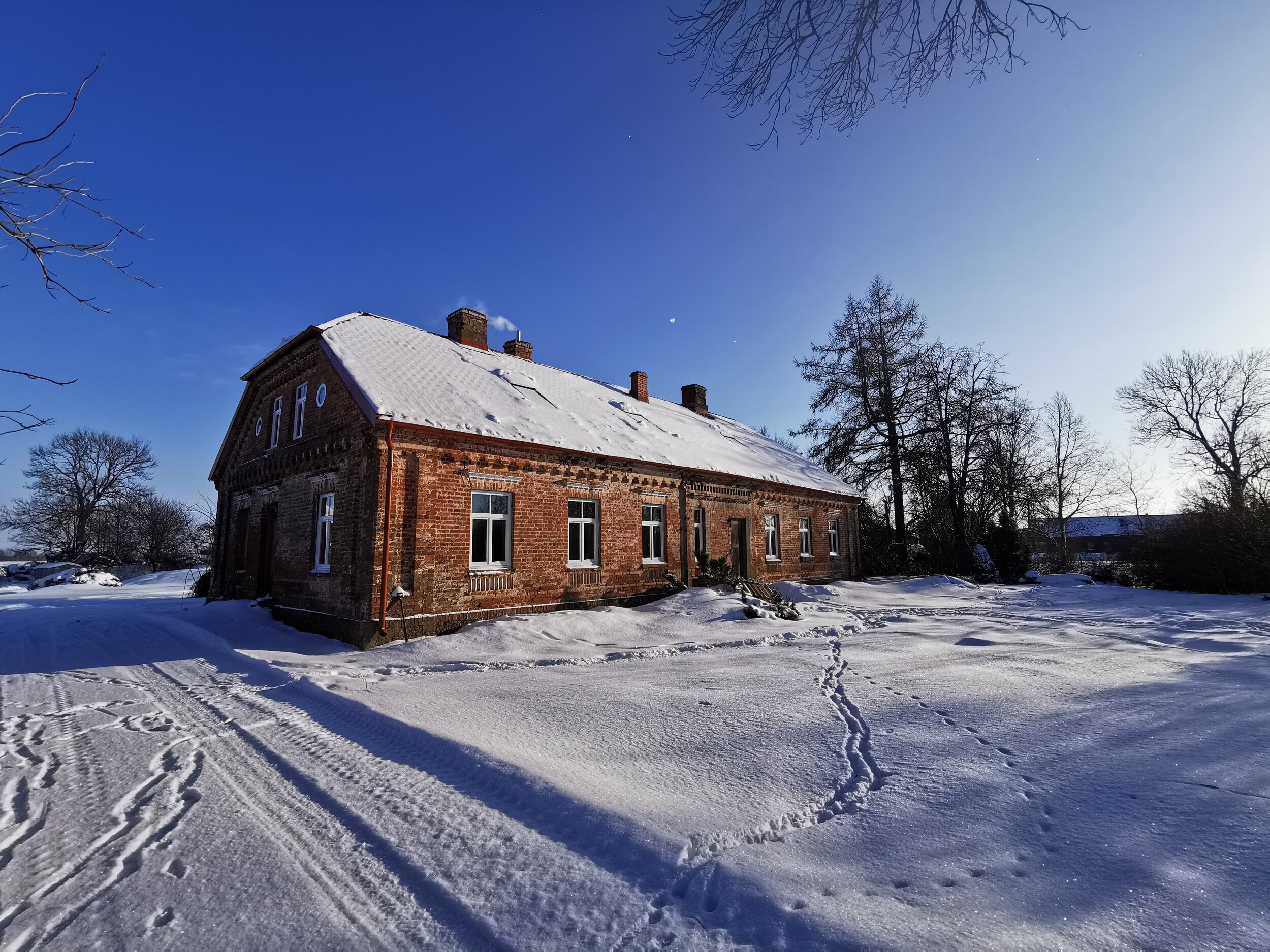
You’ll stay at our family home, a historic brick house originally built in 1878 and carefully renovated in 2021.
The house is shared with our family, including our five cats and one dog. The horses' paddock and stable are between the house and studio, just a short walk away.
Your accommodation includes:
Private guest room with a 140 cm double bed and kitchenette
Shared bathroom with shower and washing machine
Bed linen and towels
Wi-Fi
The studio is a two-minute walk from the house.
MEALS
Meals are self-catered.
The accommodation has a kitchenette where you can prepare your own breakfast, lunch and dinner.
If you have rented a car, you can also use the evenings to explore the surrounding area and visit local restaurants. Q&A — local restaurants
GETTING HERE
We are approximately 20 minutes by car from Bauska Bus Station and around 1 hour 10 minutes by car from Riga International Airport.
If arriving by public transport, we recommend travelling to Bauska Bus Station. We can provide a shuttle to and from Bauska when needed.
If you are arriving by Bolt taxi from Riga Airport, you can come directly to the studio.
A rental car gives you more freedom to explore the surrounding area, visit Rundāle Palace and go out for dinner.
PRACTICAL INFORMATION
Q&A — travel tips, arrival information and practical considerations
Booking Terms & Conditions
HOW TO ENQUIRE
Write to us at laimaceramics@gmail.com and tell us:
Your previous pottery experience, if any
What you would particularly like to learn or make
Whether you will be travelling with a companion