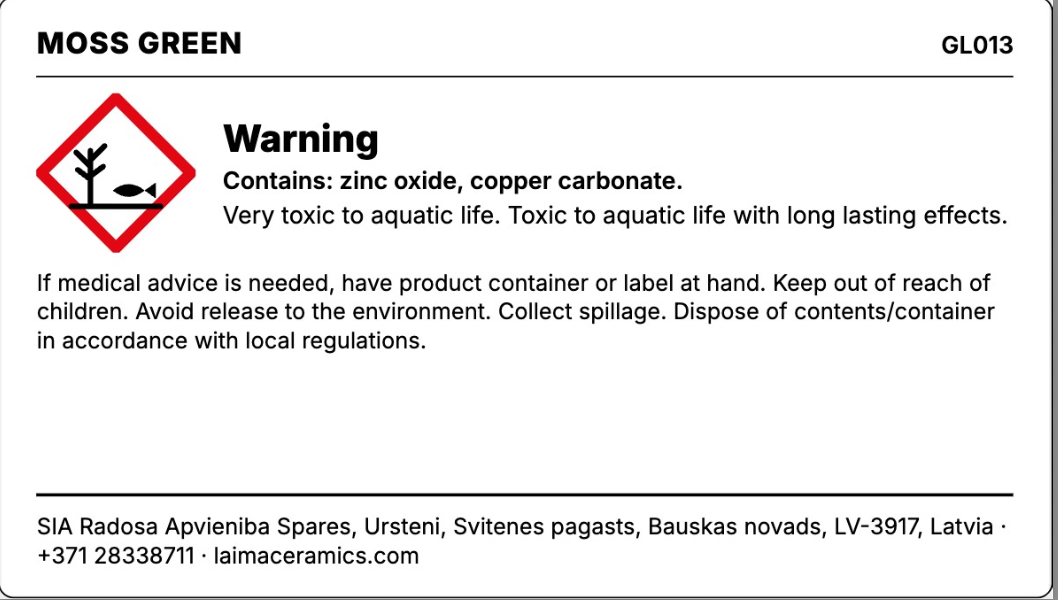
We mix every bag of Laima Ceramics glaze by hand in our studio in Latvia. We set out to write a proper safety data sheet (SDS) and hazard label for every one of them: more than 50 glazes.
A glaze powder sold in the EU is a chemical mixture in the eyes of the law, whether it comes from a large factory or a small studio. The same rules apply to us as to anyone else. This post is an honest look at what that involved, what we learned about our raw materials, and what changes as a result. We hope it helps other small makers, and gives our customers a clearer picture of what is in the bag.
The rules, in plain words
Three pieces of EU law shape what goes on and with a bag of glaze:
CLP Regulation (EC 1272/2008) decides whether a mixture is hazardous, and what its label must say: pictograms, a signal word (Warning or Danger), hazard statements (H-codes) and precautionary statements (P-codes).
REACH Regulation (EC 1907/2006) requires a 16-section safety data sheet for hazardous mixtures sold to professional users, in the language of the country where it is sold.
CLP Annex VIII requires a poison-centre notification (PCN) for mixtures with health or physical hazards, and a 16-character UFI code on their label so a poison centre can identify the exact product in an emergency.
The key point is that a glaze is classified as a mixture. Its hazards come from the hazards of each ingredient, weighed by how much of it the recipe contains. A glaze with a small amount of one hazardous oxide may need no label at all; the same oxide at a higher percentage may need a hazard pictogram and a signal word.
Step 1: an SDS for every ingredient
We can only classify a glaze if we know how each raw material is classified. So the first job was to collect the supplier's safety data sheet for every ingredient we use: clays, feldspars, quartz, frits, carbonates, colouring oxides and stains.
Two things surprised us:
The same material can be classified differently by different suppliers. It depends on purity, particle size and how much testing the supplier has done.
Names differ. Our recipes say "manganese oxide"; the supplier sheet says "Braunstein A45". Matching every recipe line to the right sheet was a job in itself.
Step 2: classifying each glaze as a mixture
With the ingredient sheets in hand, we worked through every recipe, one glaze at a time:
List each ingredient's hazard classes from its SDS (for example, Skin Sens. 1, Aquatic Chronic 1).
Work out each ingredient's share of the dry recipe, as a percentage.
Compare those percentages with CLP's concentration limits. Some hazards switch on at 1%, some at 0.1%, some only at 25% or more.
For hazards that add up (aquatic toxicity, acute toxicity), sum the contributions of all ingredients. Some substances carry an M-factor that multiplies their weight: copper oxide counts 100 times over for acute aquatic toxicity.
Turn the result into a signal word, pictograms, H-statements and P-statements for the label.
What we found about the ingredients
The good news: most of a glaze is not classified as hazardous at all. The hazards come from a short list of colouring oxides and a few fluxes.
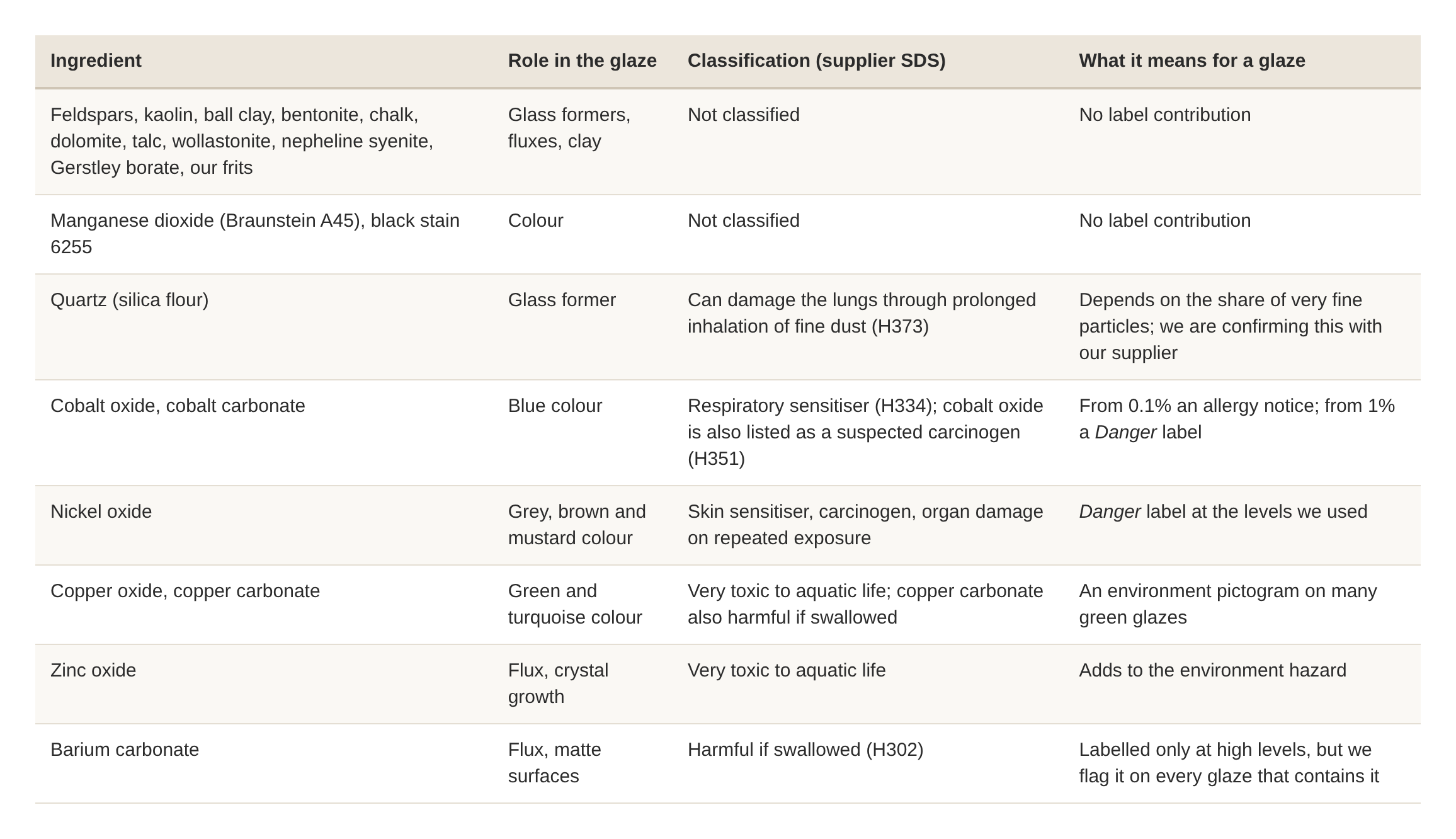
A few results changed how we think about our own recipes. Cobalt and nickel matter for the person handling the dry powder, because they can cause allergies when breathed in or touched. Copper matters mainly for the environment: rinse water should not go down the drain or into the garden.
What it means for our collection
Of 57 glazes, 24 need no hazard label at all, and only 7 carry the signal word Danger.
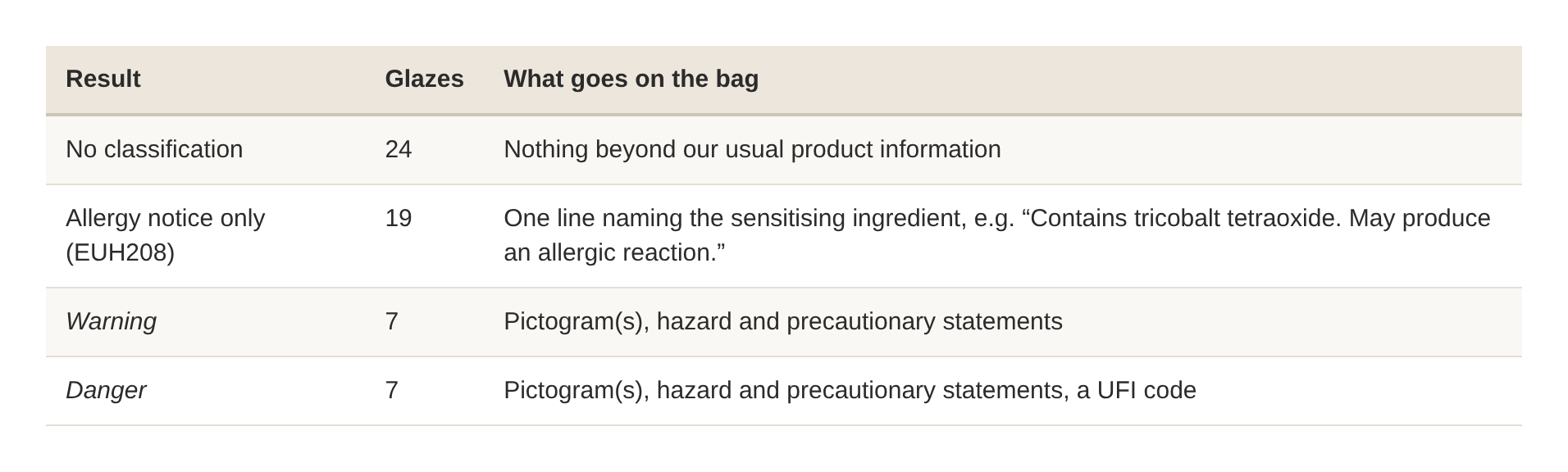
Three of the Danger glazes (Dune, Ron Grey and Ron Mustard) are there because of nickel oxide. We have moved them to a "being reformulated" section: Ron Grey will get its colour from a stain and Ron Mustard from red iron oxide instead. Once the new recipes are tested, we expect both to drop out of the Danger group.
UFI codes and poison-centre notification
A UFI (Unique Formula Identifier) is a 16-character code, like UFI: N1QV-R02N-J00N-ED1K. It links a product on the shelf to the exact recipe a company has filed with the poison centres. If a child swallows some glaze powder, the doctor reads the UFI off the bag and the poison centre knows instantly what is in it.
What we have learned about the process:
Only glazes classified for a health or physical hazard need one. A glaze that is hazardous only to the environment, or carries only an allergy notice, does not. For us, that is a small group of glazes.
You generate the code yourself, for free, with ECHA's UFI generator. It combines your company's VAT number with a formulation number you choose for each recipe.
The recipe is then filed through ECHA's poison-centre portal, in the format the EU prescribes, for every country where the glaze is sold. The filing is confidential: only poison centres see the recipe.
New labels, and what an SDS does not tell you
Our labels now carry, where needed:
the glaze name, net weight and our company name, address and phone number
pictograms, the signal word and hazard and precautionary statements, in the language of the country where the glaze is sold
a "Contains:" line naming the ingredients behind the hazard, so you can see why a label is there
a note on glazes that contain barium carbonate, even where the law does not require one
a UFI code, once generated
One thing worth saying clearly: an SDS and a hazard label describe the dry powder, the way you handle it before firing. They say nothing about whether a fired piece is safe for food. That depends on the clay, the glaze thickness, the firing and the use, and only a lab test of the finished piece can tell you. CLP also forbids words like "non-toxic" or "harmless" on a hazard label, so you will not see them on our bags.
This was not the most glamorous project of our year, but it was one of the most useful. We now know our glazes better than ever, and we can tell you exactly what is in each bag and why. Knowledge over fear, always. 🤍
This post describes our own experience and is not legal advice. Rules can differ by country and product type, so check your own case with the relevant authority.