Cutlery Marks on Matte Glazes — What They Are and Why They Happen
Matte and satin‑matte glazes are beloved for their soft, stone‑like surfaces, subtle light absorption, and quiet, earthy presence on the table. Especially in white and pale tones, they bring a sense of calm, tactility, and modern restraint that glossy surfaces cannot replicate.
However, one of the most common questions we receive from clients — and one of the most discussed topics among potters — concerns cutlery marks on matte glazes.
This article is intended as a clear, honest, and practical guide for both fellow potters and clients: what these marks are, why they appear, what they mean (and do not mean), and how to live well with matte surfaces over time.
What Are Cutlery Marks?
The grey or dark lines that sometimes appear on matte or satin‑matte ceramic surfaces — especially white ones — are often referred to as cutlery marks. Despite the name, they are not scratches in the ceramic itself.
In most cases, they are metal residue transferred from cutlery onto the glaze surface.
What actually happens?
Metal cutlery (especially stainless steel) is softer than high‑fired ceramic glaze
When pressure is applied during cutting or scraping food, microscopic metal particles are deposited onto the glaze
Matte glazes, by nature, have a micro‑textured surface that can hold onto these particles more easily than glossy glazes
This phenomenon is widely recognised in ceramic materials science and is not considered a defect.
Why Matte Glazes Show Marks More Easily
1. Micro‑Texture of Matte Surfaces
Matte glazes achieve their soft appearance through micro‑crystals, phase separation, or reduced glass flow. Under magnification, these surfaces are not smooth — they have gentle peaks and valleys.
These micro‑textures:
scatter light (creating a matte look)
increase surface friction
make metal transfer more visible
2. White and Light Colours
White matte glazes make cutlery marks more visually apparent, simply because of contrast. The same metal transfer on a darker or speckled surface may go unnoticed.
3. Type of Cutlery
Not all cutlery behaves the same:
Softer stainless steels mark more easily
Heavily serrated knives increase pressure points
Worn or poorly finished cutlery leaves more residue
Are These Marks a Sign of Poor Quality?
No.
Cutlery marking on matte glazes occurs across:
handmade studio ceramics
high‑end restaurant tableware
industrially produced matte porcelain
It is a material interaction, not a craftsmanship failure.
High‑fired stoneware and porcelain glazes are significantly harder than steel. If the ceramic were actually being scratched, the cutlery would dull rapidly — which is not the case.
Food Safety: What You Should Know
All of our glazes are:
lead‑free
cadmium‑free
formulated exclusively for functional tableware
fired to high temperatures suitable for daily use
They would pass standard food‑safety tests.
As a small handmade studio working with multiple glaze variations and collections, we do not carry formal lab certificates for each individual piece. However, all raw materials we use are intended for food contact, and all work is produced using established, functional ceramic practices.
Cutlery marks do not compromise food safety. They sit on the surface as metal residue and do not leach, absorb, or react with food.
Cleaning and Reducing Cutlery Marks
In many cases, cutlery marks can be reduced or removed with gentle cleaning:
Baking soda + water (soft paste, rubbed gently)
Ceramic‑safe cream cleaners
Melamine sponge (used lightly)
Avoid aggressive abrasives, which can polish the surface unevenly over time.
Regular dishwasher use may also gradually reduce visible marks, depending on detergent and water hardness.
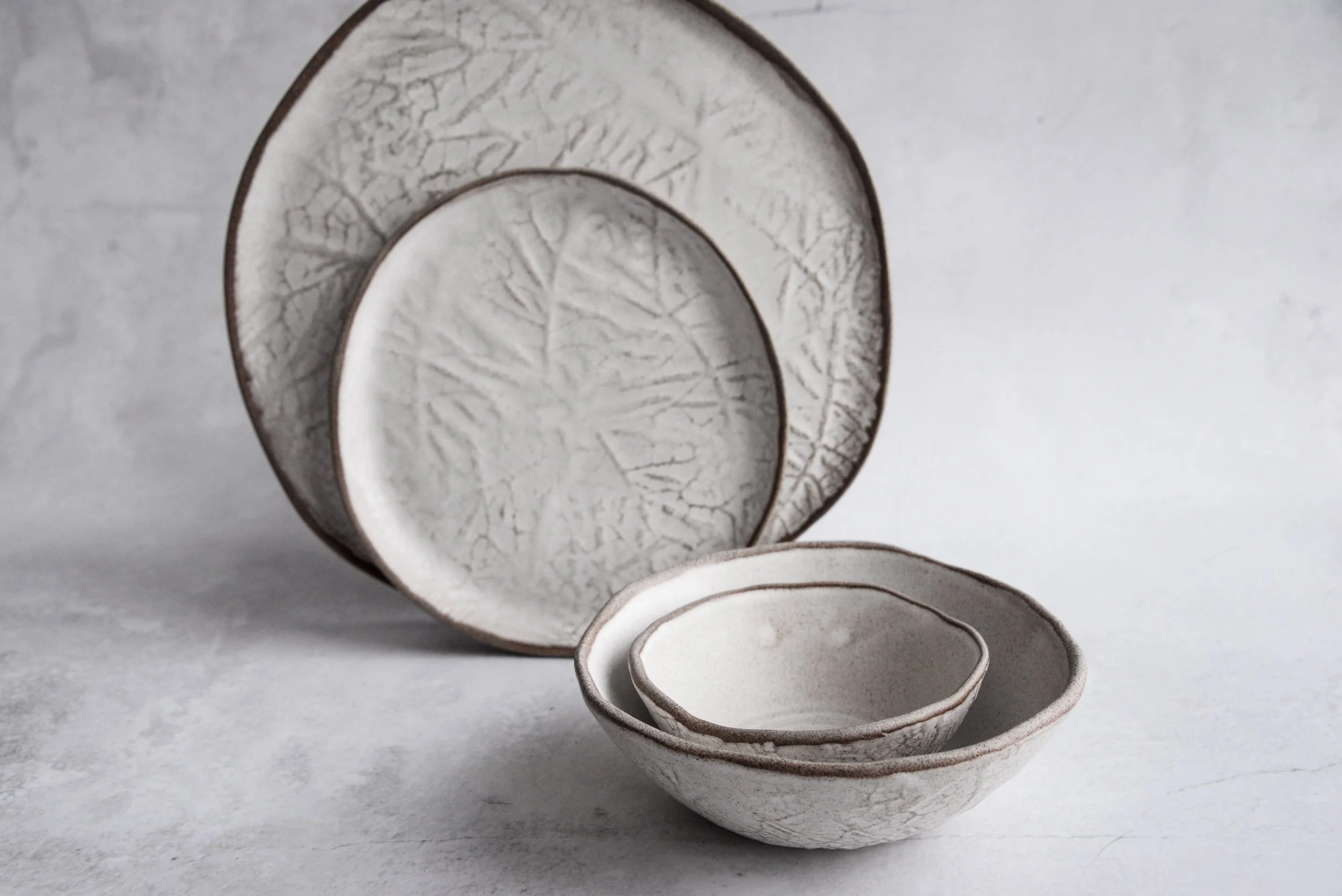
When developing our WHITE LEAF dinnerware range, we originally tested a smooth plate finished in our SNOW glaze. After the very first set of pancakes in my own kitchen, cutlery marks appeared immediately.
That moment made one thing clear: the glaze was too beautiful to abandon, but the design needed to change.
As with many of our forms, the final solution came through problem-solving rather than decoration. The leaf texture was introduced not as ornament, but as function — creating subtle surface variation that allows everyday marks to disperse, soften, and visually blend into the pattern rather than stand out.
The result is a dinnerware range that preserves the luminous calm of the SNOW glaze, while embracing real life at the table. Many designs are in fact born from listening to materials, testing them honestly, and letting function quietly guide form.
Matte vs Glossy: Choosing What’s Right for You
If you prefer a surface that:
shows fewer visible marks
requires less aesthetic maintenance
stays visually uniform longer
A glossier glaze finish is generally more forgiving with metal cutlery.
If you choose matte glazes, you are choosing:
tactility over perfection
material honesty over uniformity
a surface that records use and time
Neither is better — they simply age differently.
For Fellow Potters: A Shared Reality
Cutlery marking is one of the most persistent challenges in matte glaze development. Even well‑balanced, durable recipes may mark to some degree, especially in white and satin‑matte ranges.
Rather than eliminating the phenomenon entirely (often at the cost of surface quality or glaze stability), many studios — including ours — choose transparent communication and thoughtful material choices.
Educating clients builds trust and appreciation for the nature of handmade ceramics.
Living With Use
Ceramics are not static objects. They are meant to be touched, used, washed, stacked, and shared.
Matte glazes tell a quieter story — one of daily rituals, meals prepared with care, and objects that live alongside us rather than remaining untouched.