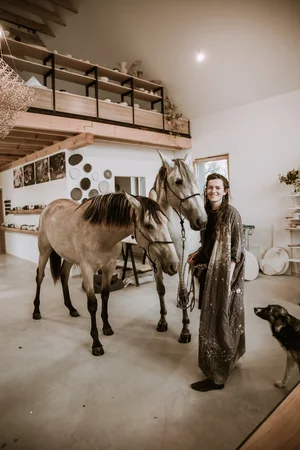
MOON Collection — Stuff of the Stars
When I was a craft student in the UK (Falmouth University, 2010–2013), the heart of my education wasn’t just the studio space and the amazing Design Center technical workshops — it was the library. Coming from the middle-of-nowhere countryside in Latvia, stepping into that place felt like walking into a cathedral of knowledge. Shelf after shelf of every book and journal on art, craft, design, chemistry, sculpture, material history… It was Disneyland for my young makers mind.
Somewhere deep in my research one afternoon, I picked up a journal with an article titled “Stuff of the Stars.”
It explored crater and lava glazes, and specifically the strange, alchemical role of silicon carbide.
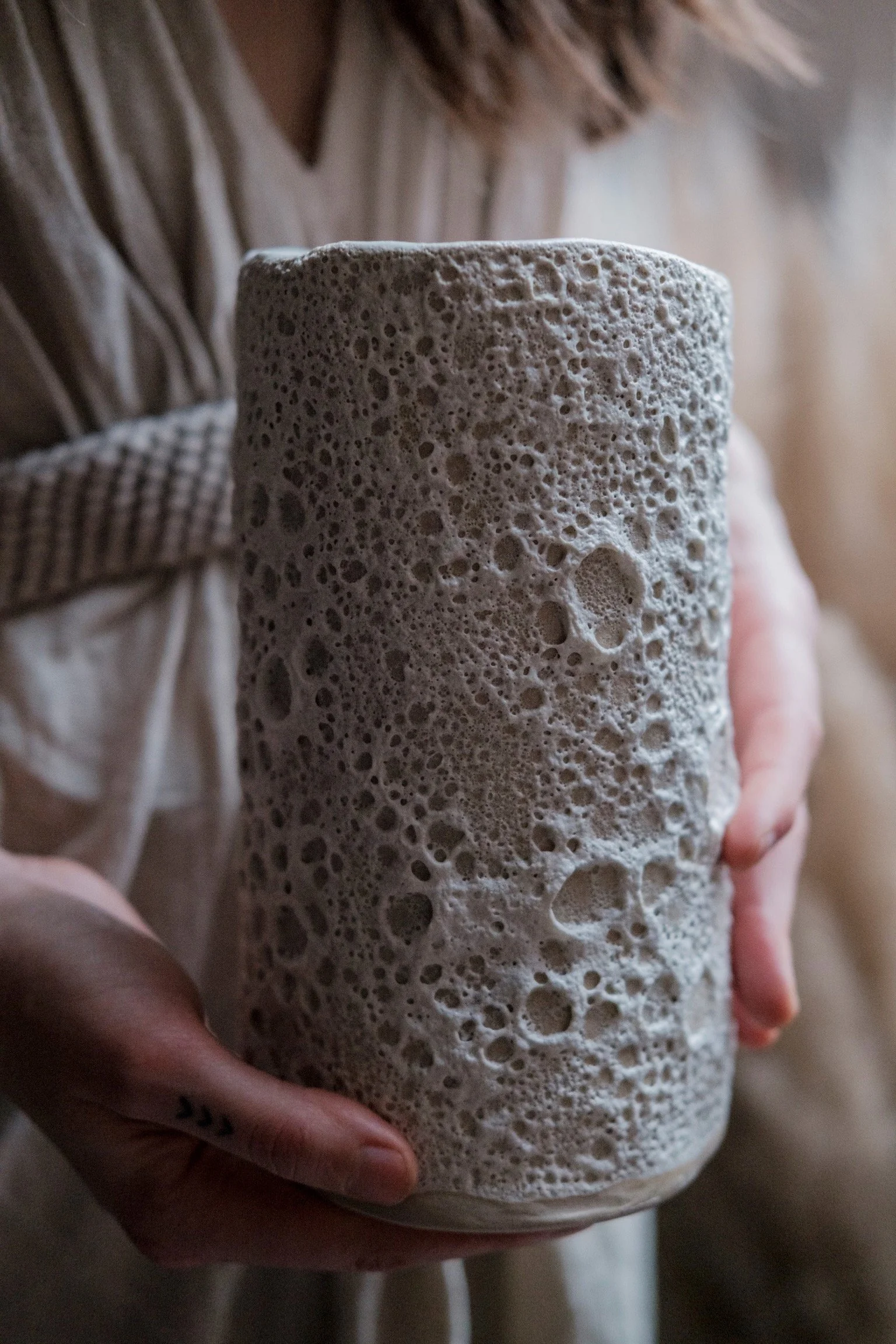
I was instantly drawn to it — this idea that a glaze could bubble, crater, blister, erupt; that it could mimic volcanic stone and cooled meteor surfaces; that chemistry could be sculptural. I began experimenting almost immediately, and lava glaze has been in my work ever since 2012.
But for a long time… it felt like people weren't quite ready for it.
I loved the rawness, the geological aesthetic, the controlled chaos — but customers gravitated toward my smoother, more familiar surfaces. I kept making it in small amounts, exploring it quietly.
And then suddenly — it felt like everyone was asking:
What is this? How did you make this? Where does that texture come from?
Finally, the little alchemist in me — the one who fell in love with crater glaze at 20 years old in a library — could shine. I would begin telling the story the same way every time:
“Well… it starts in 1893, with a meteorite.”
A Brief History of Silicon Carbide — From Stars to Studio Kilns
Long before silicon carbide ever entered a ceramic glaze, it existed in the universe as stardust. It forms naturally only in extreme environments — inside dying stars — and on Earth it appears almost exclusively in meteorites.
In 1893, mineralogist Ferdinand Henri Moissan discovered tiny crystals of silicon carbide inside a meteorite crater in Canyon Diablo, Arizona. It was so rare and so unusual that at first he believed he had found a new form of diamond. Only later was the mineral identified and named moissanite.
But nature offered only microscopic traces.
To use this cosmic material on Earth, humans needed a way to make it themselves.
That breakthrough happened just a few years earlier, in 1891, when American inventor Edward Acheson accidentally created synthetic silicon carbide while trying to grow artificial diamonds. Instead, he found glittering crystals lining his furnace walls — identical to the mineral Moissan would later find in a meteorite.
By the early 1900s, silicon carbide (sold commercially as carborundum) was being produced industrially for abrasives, tools, and high-temperature applications.
It wasn’t until the mid-20th century that adventurous ceramic artists began adding silicon carbide to glazes, discovering that it could:
release gases as the glaze melts
create volcanic, cratered textures
mimic meteorite surfaces
form bubbling landscapes reminiscent of cooled lava
It wasn’t widely used at first — early versions were unpredictable and required careful balance. But pioneers such as Otto Natzler, Val Cushing, and studio potters across Europe and Japan began exploring crater glazes, each using silicon carbide to create textures that felt ancient, lunar, or volcanic.
Because silicon carbide behaves like nothing else.
When added to glaze, it reacts as the silica and flux melt, releasing gases that push upward — creating craters, blisters, and pitted landscapes.
How It Became the Heart of the MOON Collection
When the world finally began noticing those crater textures in my work — after nearly a decade of playing with them quietly — it felt like everything came full circle. The same glaze that first captivated me in that Falmouth library became the signature voice of the MOON Collection.
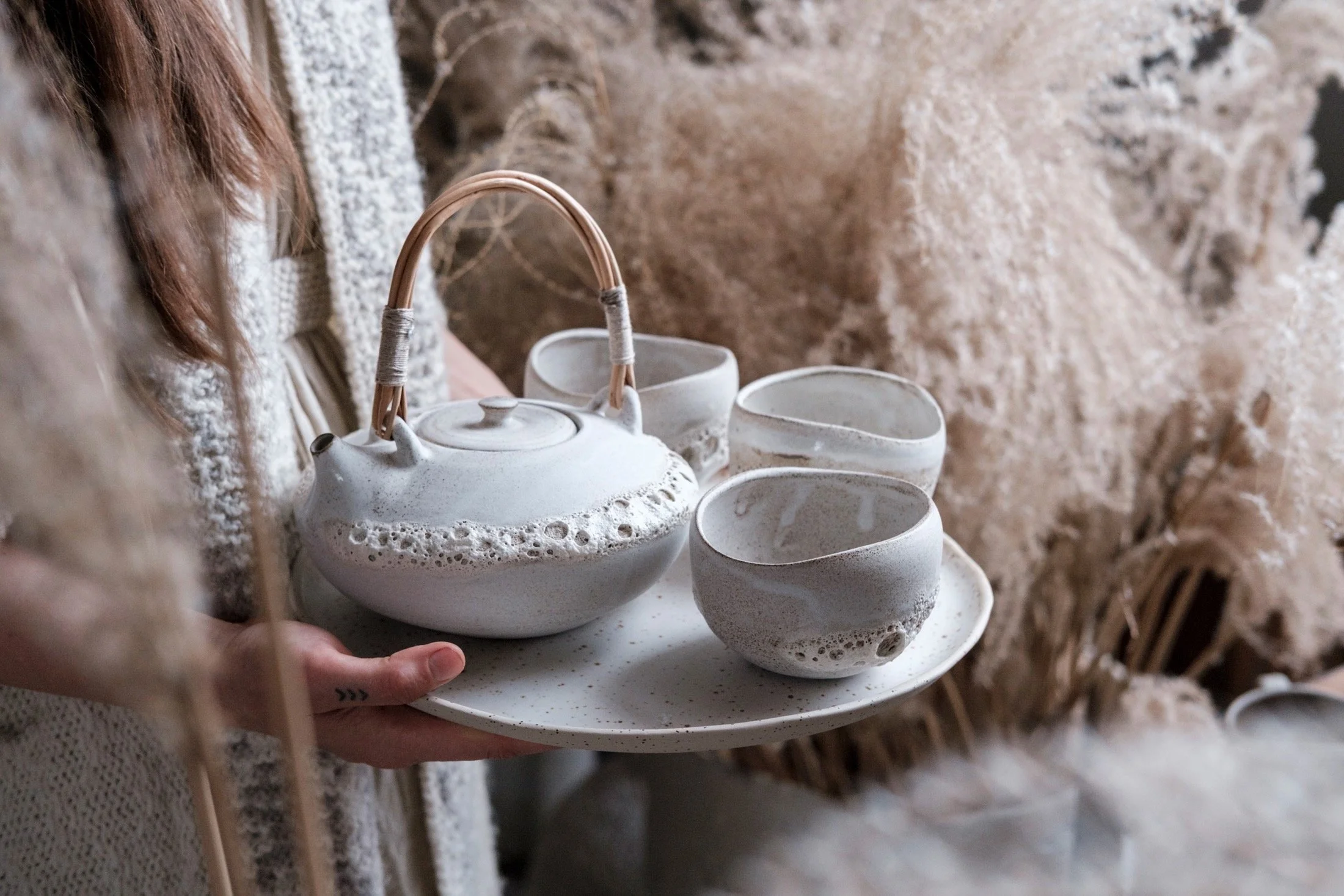
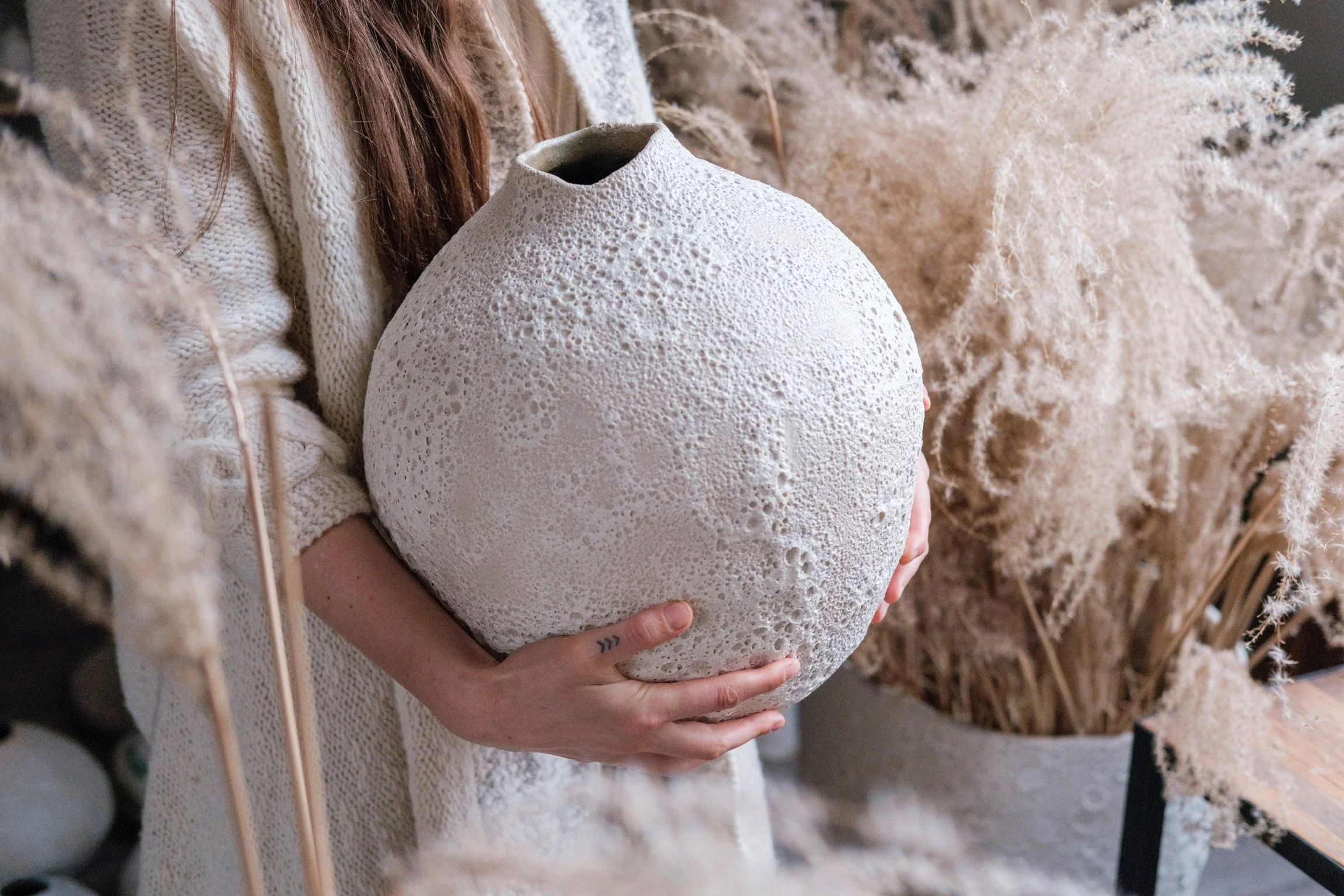
For many years, I glazed entire pieces in lava glaze — often pairing it with dark metallic bronze so it dripped dramatically into the volcanic surface. It was striking, sculptural, a kind of geological theatre in the kiln. But if you know me, you know my heart lies with functional work: pieces meant to be used, lived with, held. Full lava glaze worked beautifully on vases, but not so much on functional ware. It was only recently that I discovered another way: using the crater glaze as a fine inlay against the pure white Snow glaze. Suddenly the entire character changed — from a fully dramatic eruption to a delicate, lace-like seam of texture. The contrast became finer, more nuanced, quietly expressive rather than overwhelming.
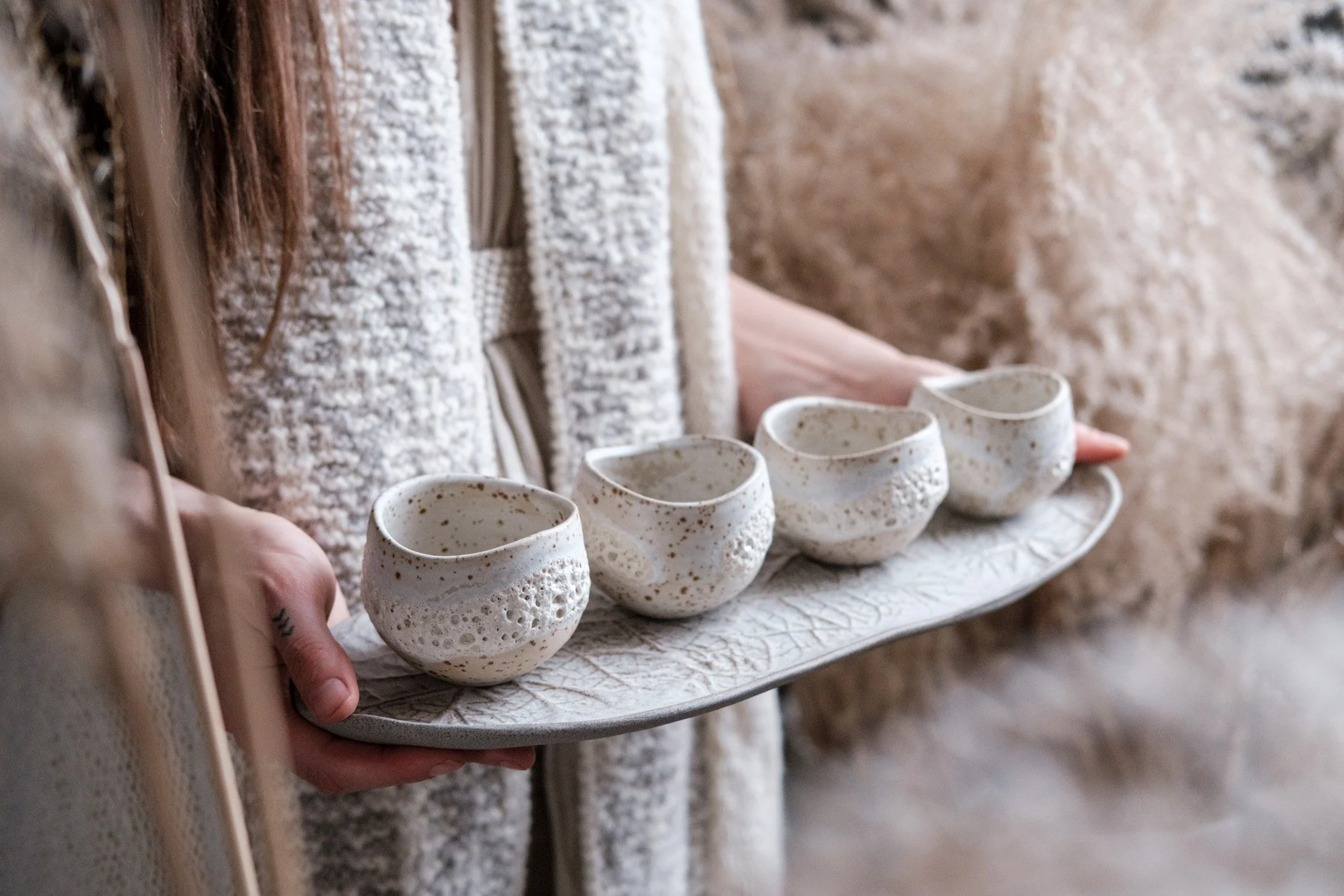
And by then, after a decade of experimenting, I had mastered the recipe and kiln settings enough to achieve almost consistent results: lava that was not too thick or too thin, bubbles that melted gently without leaving too many hollow cavities, a surface that was subtly glossy and smooth to the touch — not coarse or abrasive like many sculptural lava surfaces tend to be.
This inlay finally allowed the glaze to live where I always wanted it to: in everyday tableware, integrated into whole sets, carried into the rituals of daily life.
The luminous white Snow glaze represents clarity, purity, the quiet surface of winter light.
The crater glaze — textured, raw, elemental — represents lava, meteorites, the ancient earth.
Together, they echo the dialogue between softness and force, stillness and eruption, moonlight and stone.
A pairing born in a university library, shaped through years of experimentation, and only fully understood when the world finally asked:
“What is this magic?”
Over the years, after I began sharing more of my crater textures online, hundreds of fellow potters on Instagram reached out asking about my process.
Eventually, I decided it was time to open the doors a little wider and share what twelve years of testing, refining, and kiln-watching had taught me. That’s how my Lava Glaze Ebook was born — a guide containing my favorite recipes.
But very quickly potters began telling me the same thing:
“The recipe is amazing… but I’m not getting the finish you get.”
And they were right — lava glaze is equal parts chemistry and technique. So, together with my husband, we filmed a LAVA Mini Course, focusing on application methods, firing tips, troubleshooting, and all the tiny adjustments that save you from the frustrations that naturally come with glaze testing. LEARN GLAZING HERE
If this cosmic, cratered surface inspires you the way it inspired me all those years ago in that Falmouth library, I hope these resources help you find your own version of it — your own small piece of stardust made in the fire.