The Quiet Birth of the STONE Collection

The STONE Collection was born in one of the quietest chapters of my studio life.
When the pandemic arrived, everything that normally filled my days with movement and conversation simply… stopped. Our courses and retreats were cancelled, restaurant and gallery orders nearly disappeared, and there were no local or international workshops to prepare for. The phone, once busy with planning and logistics, fell silent. It was just me in the studio — and the cats — listening to a kind of stillness I had never experienced before.
What kept my small business afloat were a handful of wholesale partners and, unexpectedly, Etsy. Sales there tripled. I suppose with restaurants closed, people began seeking restaurant-worthy tableware for their homes, and suddenly handmade ceramics felt more essential: a way to bring warmth, ritual, and care to the everyday. For this support, we were deeply grateful.
And in this spacious quiet, something new began to take shape.
The STONE Collection emerged from that solitude — a return to the forms that first defined my craft back when I was a student at Falmouth University in Cornwall in 2012. I’ve always been drawn to what I now call organic minimalism: shapes meant to be cradled in the hands, held close, grounding by touch alone. Very practically, I’ve always had cold hands — so why add a handle when what I really want is to wrap my palms around warmth?
The early pieces of the STONE Collection carried this instinct forward: soft, pebble-inspired curves, raw tactile surfaces, and a sense of calm shaped directly by the quiet hours of those years. Out of uncertainty, a collection grew that feels rooted, honest, and close to the body — tableware made to be held rather than simply used.
Finding My Own Language in CERAMICS
Since establishing my studio in 2013, I made more and more work each year — exploring, experimenting, saying yes to almost anything clay invited me into. I loved elegant feet and soft curves, never the strict straight lines, and yet I was always open to bespoke orders. I didn’t want to limit myself; I wanted to learn. But the truth is, saying yes to everything slowly blurred the edges of my own creative voice.
When you can make almost anything… you eventually face the harder question:
“But what do I actually want to make?”
After eight years of potting, I realised that my practice had become a little muddled. The quiet of the pandemic allowed me to sit with that question, and in that stillness the early shapes of the STONE Collection began to surface.
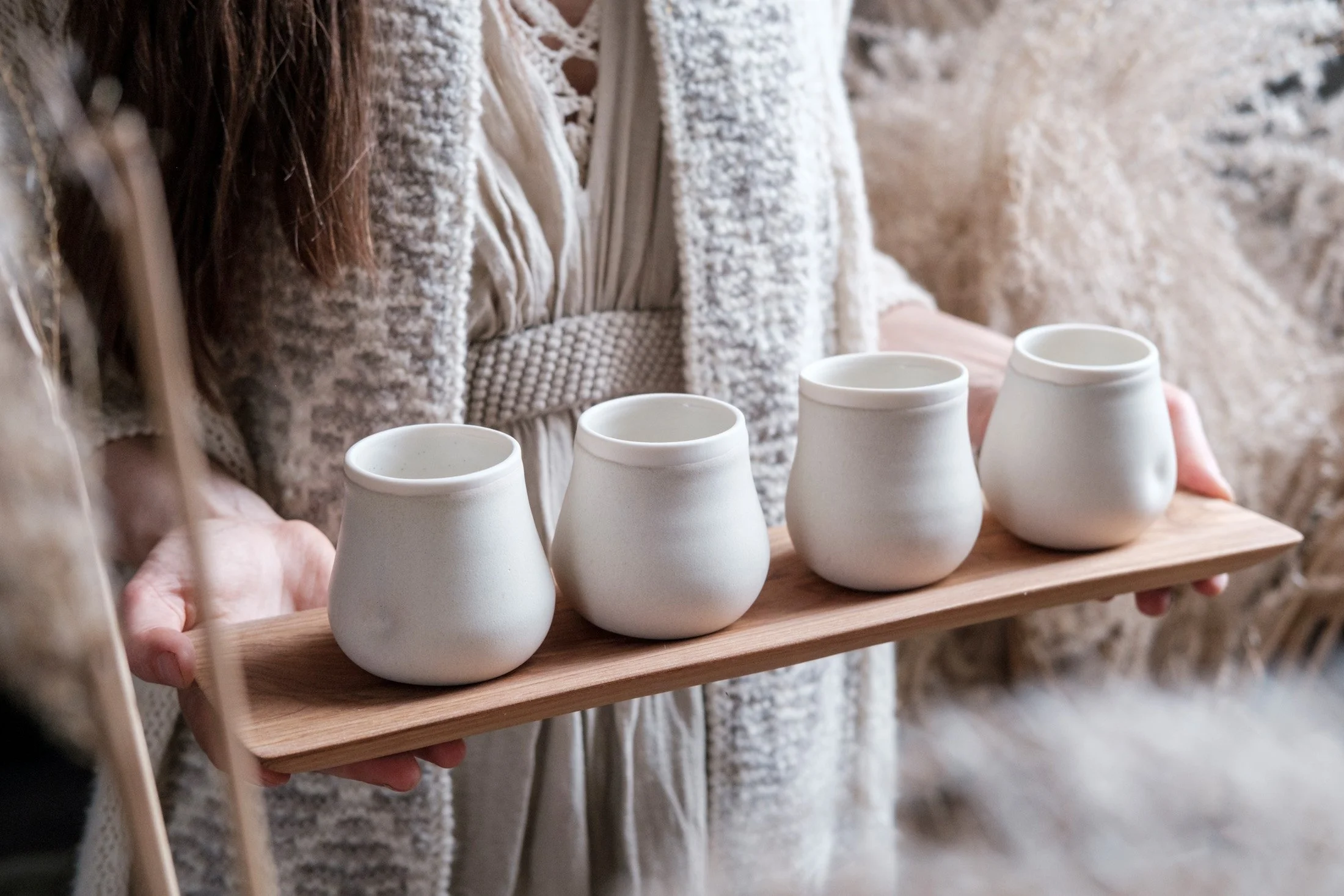
*Pictured ORGANIC cups in beige matte Sahara, continuation of my first ever design from 2012.
It started with a simple idea: Pebble.
Raw. Unglazed. Rounded. Asymmetrical.
A form that feels like it has been softened by touch and time, not engineered to perfection but shaped by instinct.
From there, all the other shapes unfolded — bowls, cups, plates, each one leaning toward the same gentle language of containment and calm. And then came the silhouette that felt like a confession: the inverted edge, the shape that tucks inward like an introvert folding into themselves for comfort.
Only during those years did I finally admit this truth to myself:
That inward-turning rim I kept sketching, shaping, reshaping — it was me.
The introvert I had always been, despite years of trying to blend in, fit in, be more social, less awkward. That rim felt like home, like permission.
The STONE Collection became not just a design line, but a moment of clarity — the place where my personal nature, the tactile world I crave, and the language of ceramics finally aligned.
A Collection Born in a Single Day
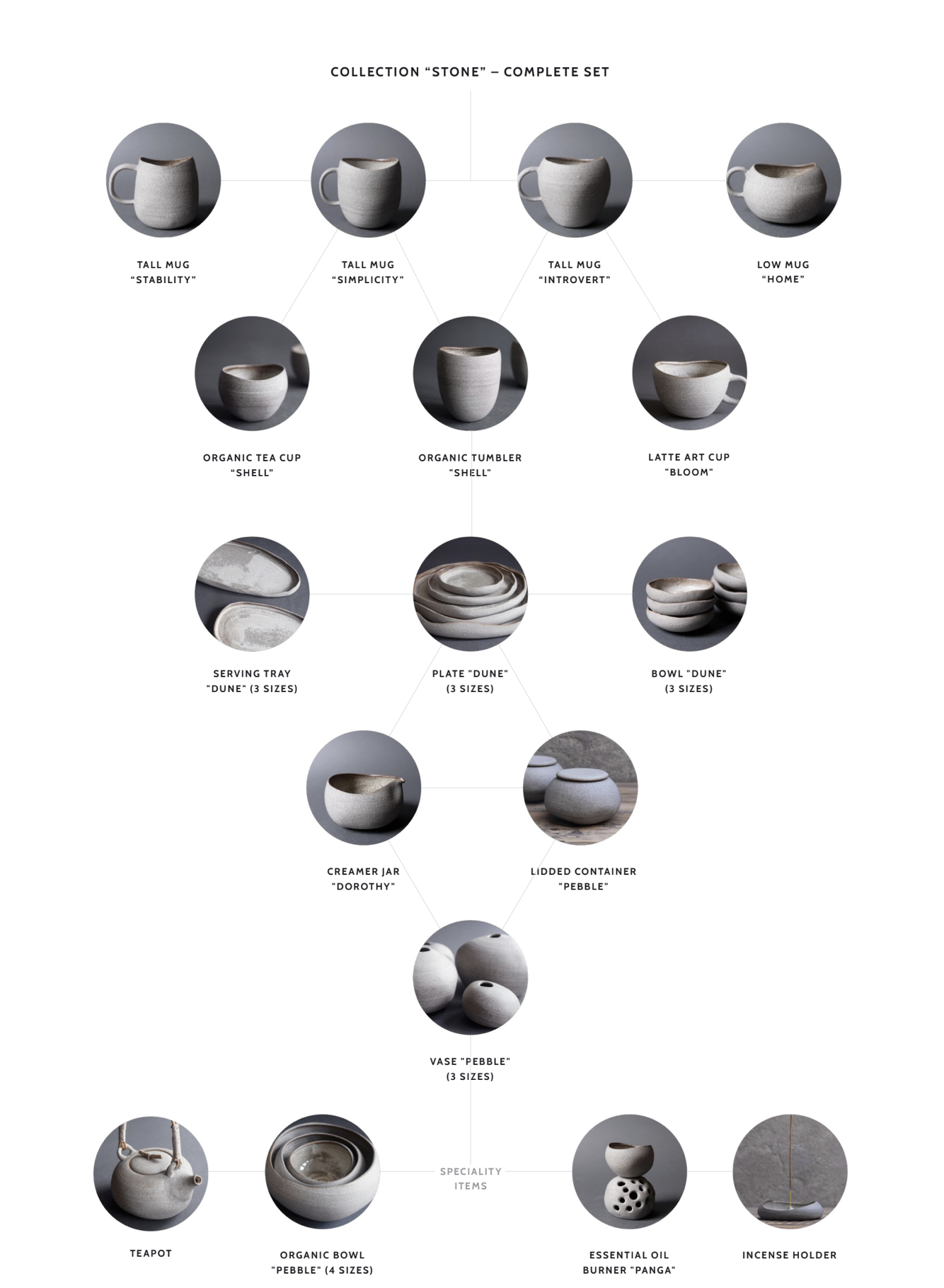
When the idea finally arrived — clear, quiet, and certain — the STONE Collection poured out of me all at once. Almost the entire range was born in a single day. I sat at the wheel and shaped every form: cups, mugs, bowls, teapots, jugs, vases. Then I moved to the slab-rolling table and formed the plates and platters to complete the family.
Of course, it took several days to refine, trim, and finish everything, but the moment of creation felt like one single breath.
From that day on, the collection has lived and evolved with me. There have been refinements, quiet improvements, and new additions: the Stacked Pebble essential oil diffuser, the tiny mini-Pebble bowls, the BLOOM latte cups, the Incense holder and Lidded Jar that arrived a little later.
Yet the core spirit has stayed unchanged.
Born in a moment of clarity.
Guided by instinct.
A return to forms that feel like HOME to me.
Recognition, Reframing, and the Turning Point
Some years later, I received an invitation to submit the STONE Collection to the Latvian National Design Award. And—true to how I’ve always lived—when life invites me, I say YES. My whole career has unfolded through these small and big intuitive yeses.
So I agreed.
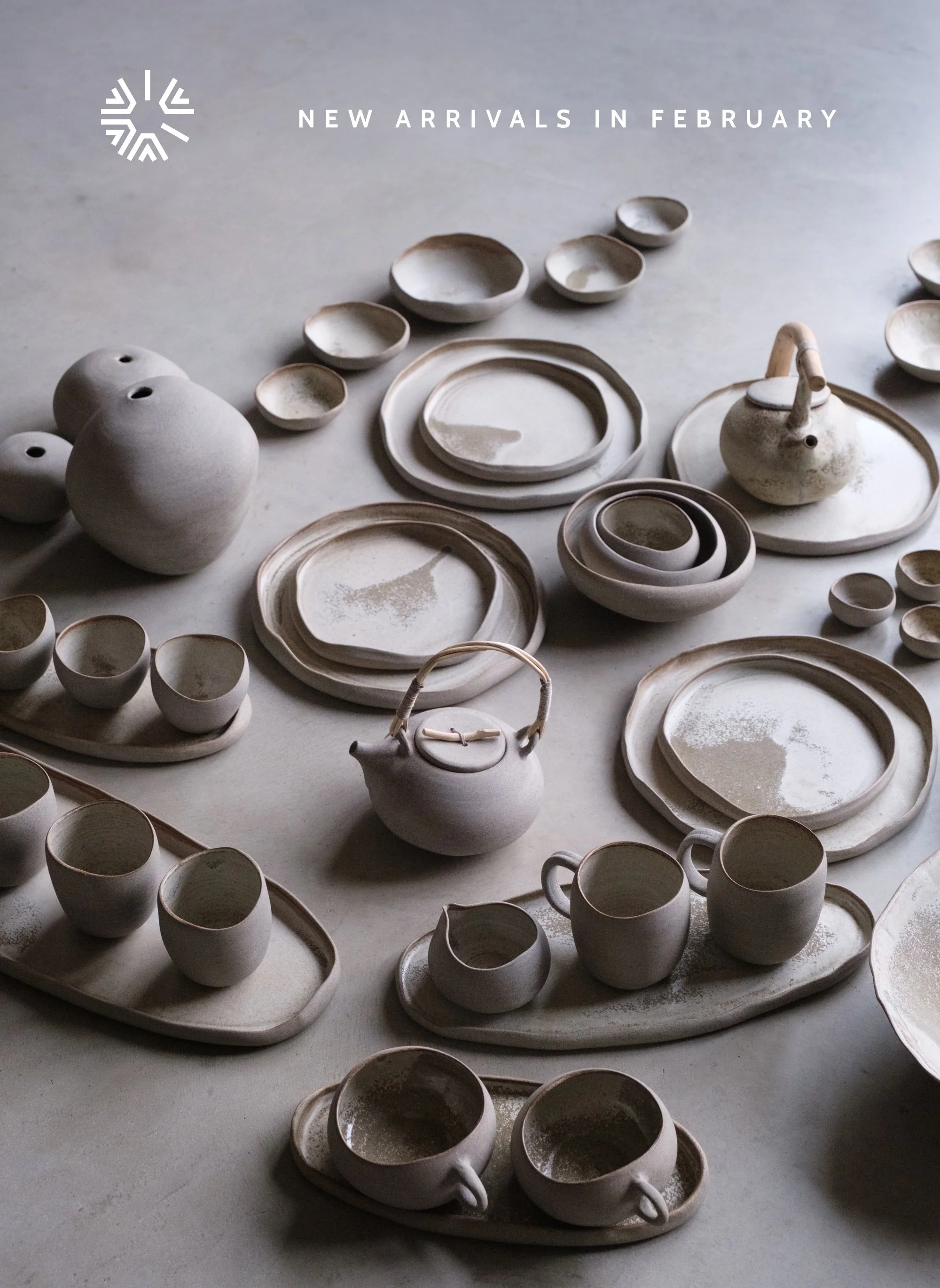
My husband and I created a photoshoot together, capturing the pieces in the most honest way we knew how — placed simply on a concrete floor. We also packed up the whole range and brought it to a gorgeous hotel, hoping to photograph the work within its beautiful, minimal interiors. We tried everything: styled table settings, curated coffee corners, carefully arranged compositions.
But in the end, the purity of the concrete floor won.
The pieces looked most themselves there — quiet, grounded, unadorned.
It was another reminder that with this collection, less is more.
We didn’t win the prize, but we received a nomination — and somehow, that was exactly what I needed. It shifted something in me. It allowed me to recognize the value of the design I had created, not as a series of ongoing experiments, but as a complete, coherent body of work. A collection with its own identity, its own voice, its own quiet presence.
It felt like my eight years of studio practice had been gently guiding me to this point all along.
PEBBLE Vase
The PEBBLE Vase is the original seed of the STONE Collection — the first form that revealed the tactile, organic language the entire range would grow from. These small bud vases begin on the wheel as complete spheres: first pulling up a cylinder, then expanding the belly the way one might when throwing a teapot, and finally narrowing the neck until the form closes entirely, trapping a pocket of air inside.
After drying, a tiny hole is pierced to let that air escape. Only then can the sphere be gently beaten, tapped, and encouraged into asymmetry — the air inside giving it just enough resilience to prevent collapse during this sculptural distortion. The small opening of the vase is finally cut, off-centre and organic, giving the form a sense of direction and breath.
What emerges is a vessel that feels discovered rather than made:
a sculptural, stone-like form with soft, irregular curves, an object that needs very little to express a lot. Each Pebble Vase holds the essence of the collection — quiet imperfection, natural tactility, and a kind of humble presence that invites stillness.
A form born from instinct, patience, and allowing nature to speak for itself.
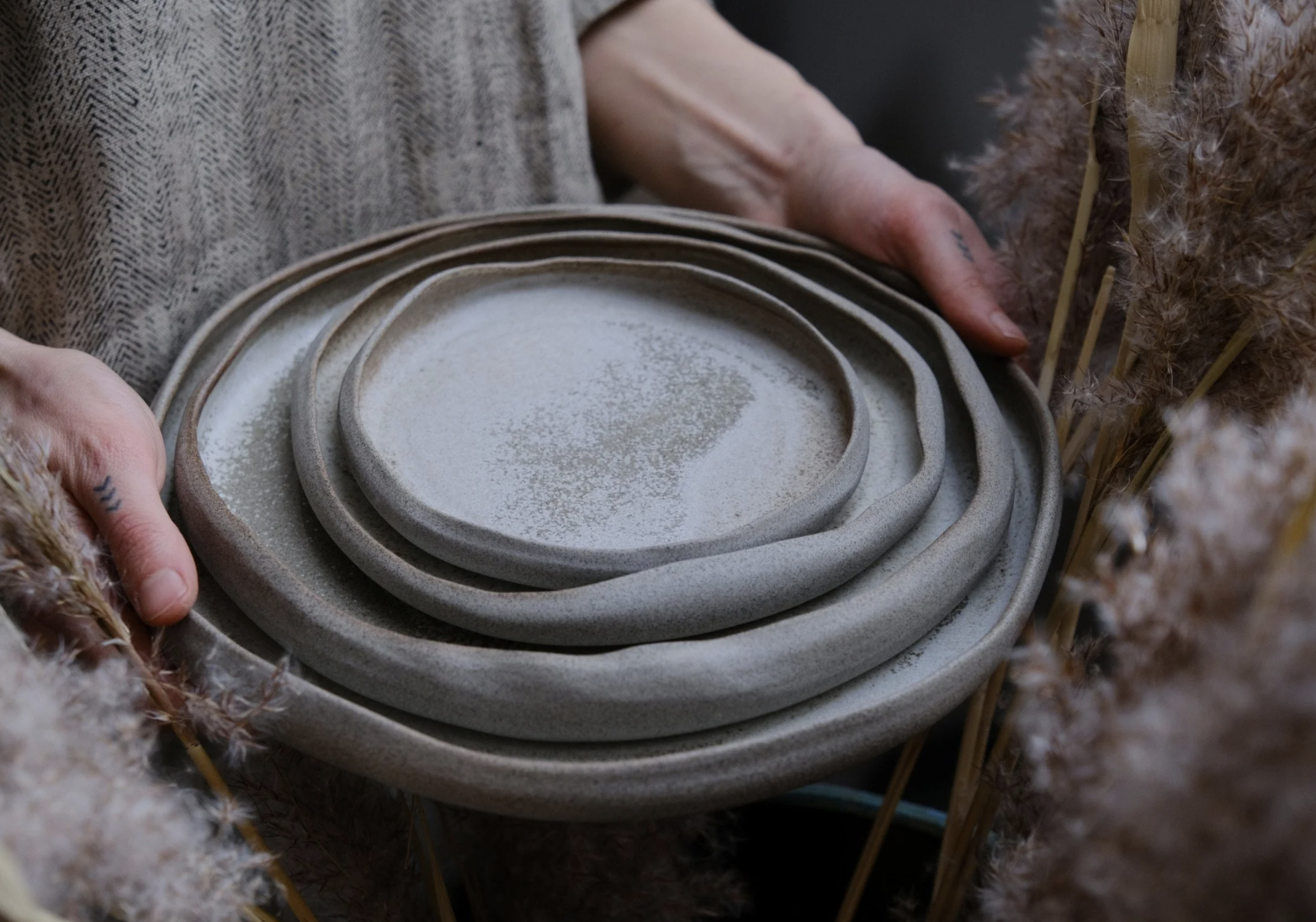
DUNE Plate Range
Defined by a raw, unglazed exterior that undergoes three stages of hand-polishing, the surface reveals a softly worn, stone-like tactility — grounding, serene, and deeply organic. The gently undulating rim and rounded silhouette celebrate the quiet beauty of imperfection, creating a plate that moves effortlessly between function and sculptural presence.
Inside, a warm beige-grey glaze flows over the form, settling into delicate crystalline and crackle patterns unique to each piece. Where the glaze gathers, glossy pools form; where it thins, softer mineral tones breathe through. The surface feels alive — shifting subtly with light, echoing the movement of sand shaped by wind or tide.
Is it matte or glossy?
Both.
This signature stone glaze responds to thickness and flow:
Thicker areas soften into a gentle gloss, reminiscent of natural ash glazes.
Thinner areas remain more matte and grounded, revealing warm clay tones beneath.
This interplay creates a landscape of textures, a quiet depth that turns each plate into a one-of-a-kind terrain. Designed with versatility in mind, the DUNE plates serve equally well as everyday dinnerware or as sculptural foundations for more intentional table rituals — a modern interpretation of wabi-sabi simplicity.
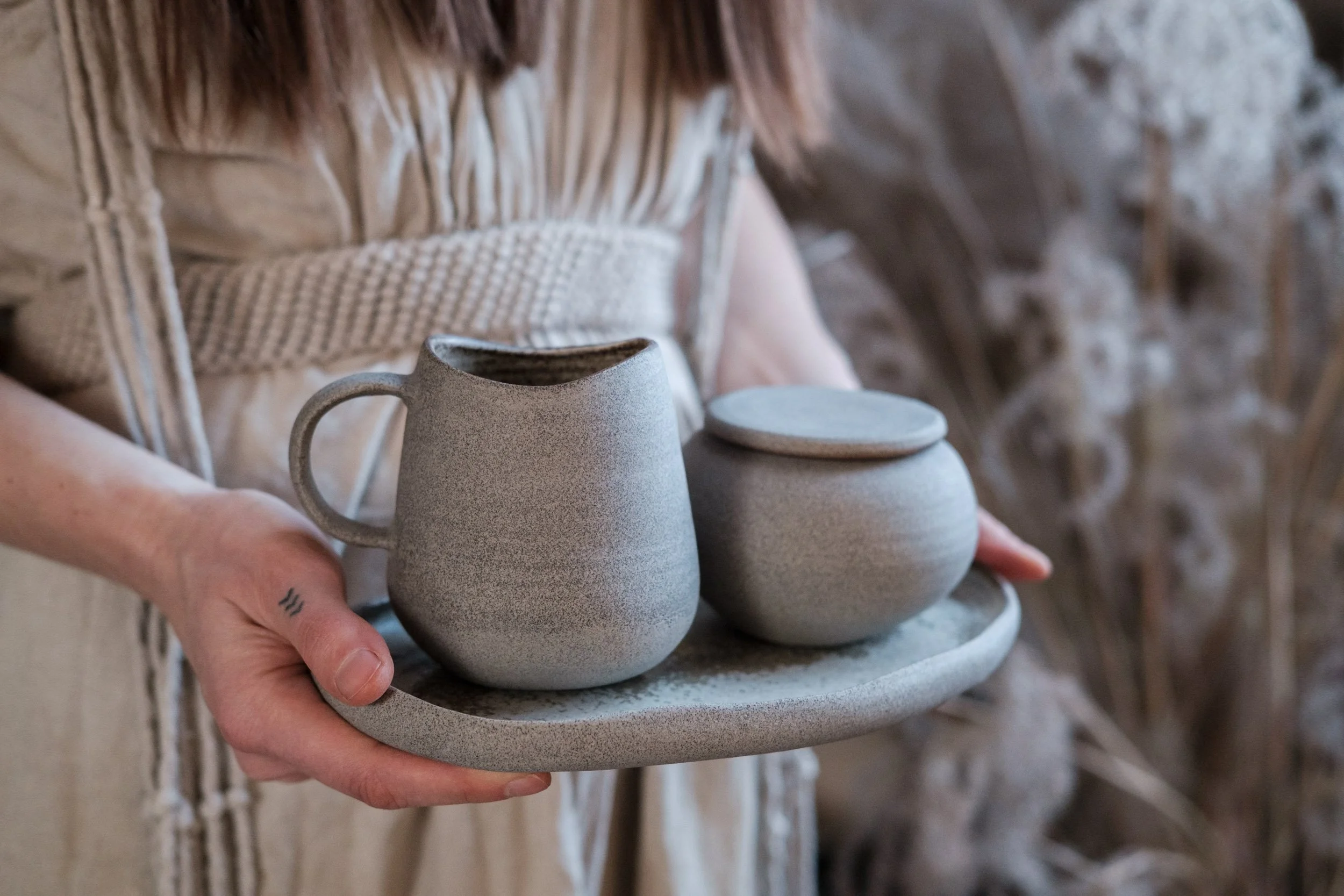
STABILITY Mug
A winter-inspired shape with a grounding presence. The STABILITY mug widens at the base and tapers toward the top, creating a reassuring silhouette that feels rooted in the hands. Its narrowed opening holds warmth close, making it a quiet companion for cold mornings, slow evenings, and grounding rituals.
A vessel shaped for steady comfort — for anchoring the senses and gathering warmth inward.
(Pictured together with DUNE oval platter and PEBBLE jar)
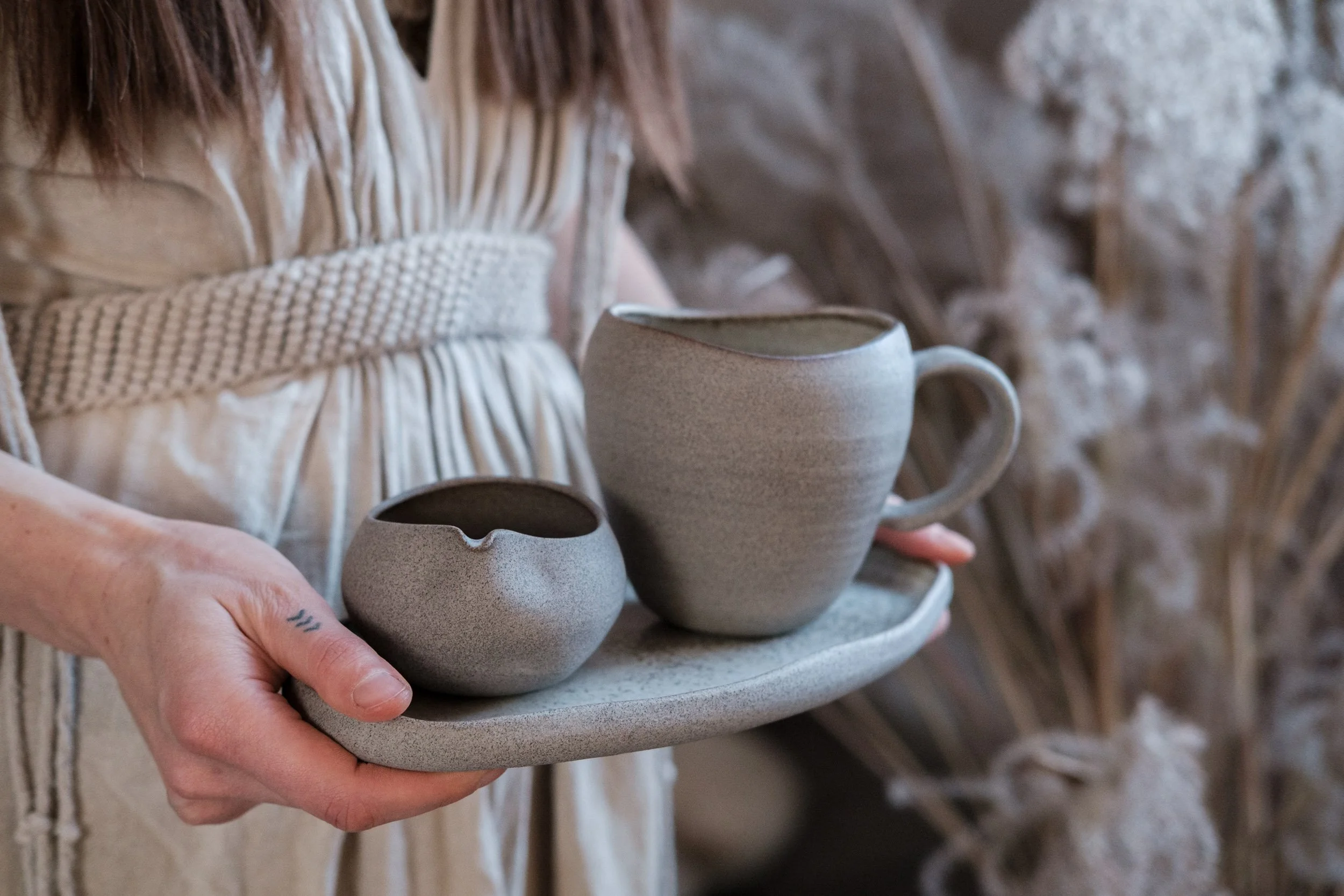
INTROVERT Mug
A gently inverted, inward-turning rim (like Japanese winter vessels) — a form that tucks inward like someone seeking shelter. The INTROVERT mug feels intimate, quiet, and protective. Its silhouette offers a subtle emotional gesture: drawing warmth in, offering it only to the hands that hold it. A comforting vessel for reflective rituals.
Its base can even seem a little wobbly — a striking contrast to the STABILITY mug. The INTROVERT mug feels better when held close than viewed from a distance; it’s meant to be cradled, not placed at arm’s length on a table. A form that reveals itself only through touch.
At one point I thought to call it “Instability,” but that felt unkind.Introvert felt truer — not as a limitation, but as an inner world.
And despite its inward rim and quiet name, the INTROVERT mug is, interestingly, a more open summer shape: generous at the top, allowing drinks to cool, inviting warmth to rise. Much like me — maybe socially anxious at times, yet with so much to share once I open.
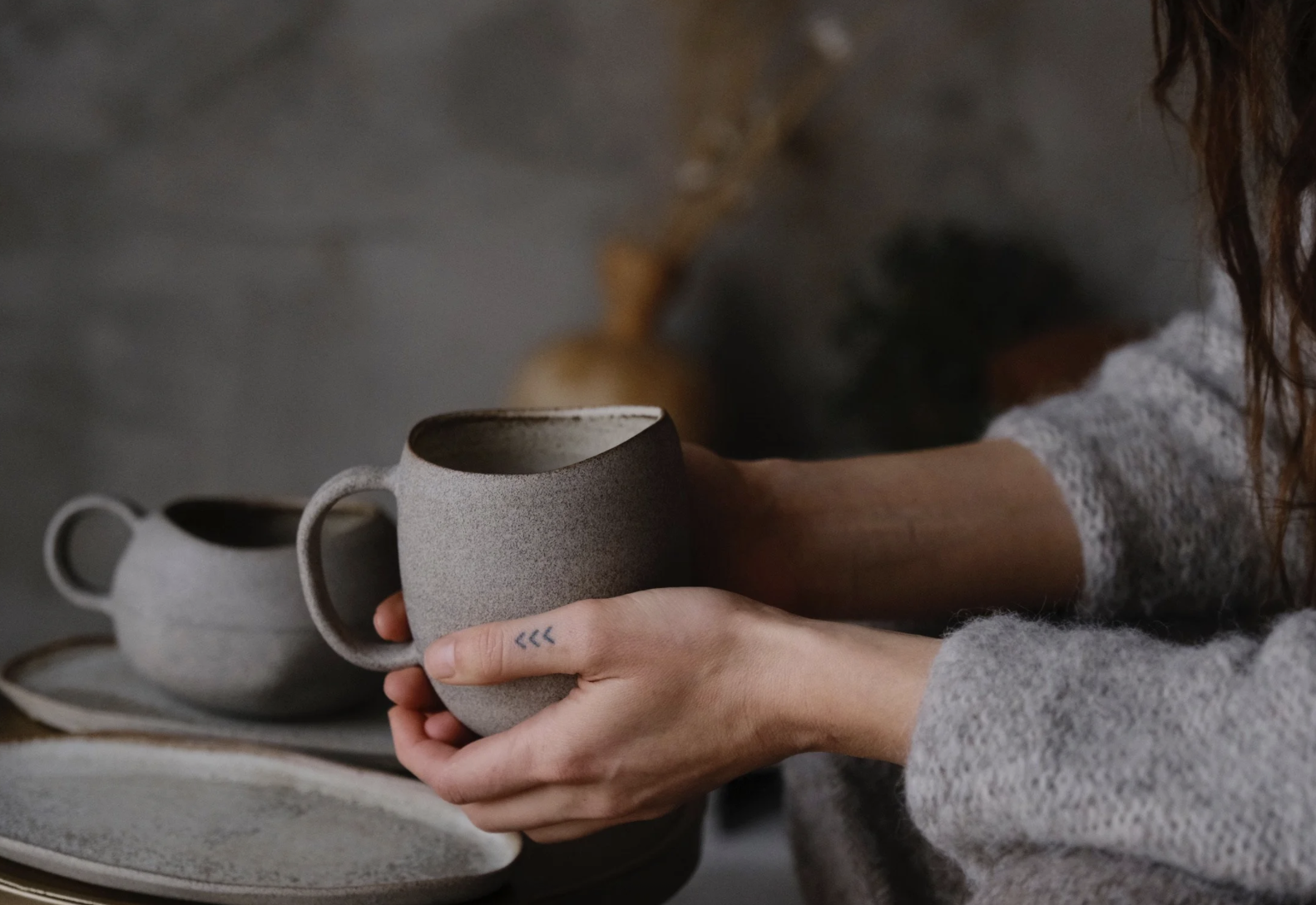
SIMPLICITY MUG
The silhouette is intentionally understated: classic straight walls with quiet, natural variation, a rounded base that rests comfortably in the palms. The SIMPLICITY mug embraces usable minimalism — nothing extra, just form and function in quiet balance. Ideal for everyday drinking rituals when calm clarity is what you’re seeking.
Whenever I try to describe this mug, no words really come — only the feeling of simplicity. In truth, even these sentences feel like too much. Words tend to pull us away from what this form really is: a quiet, honest vessel that needs no explanation.
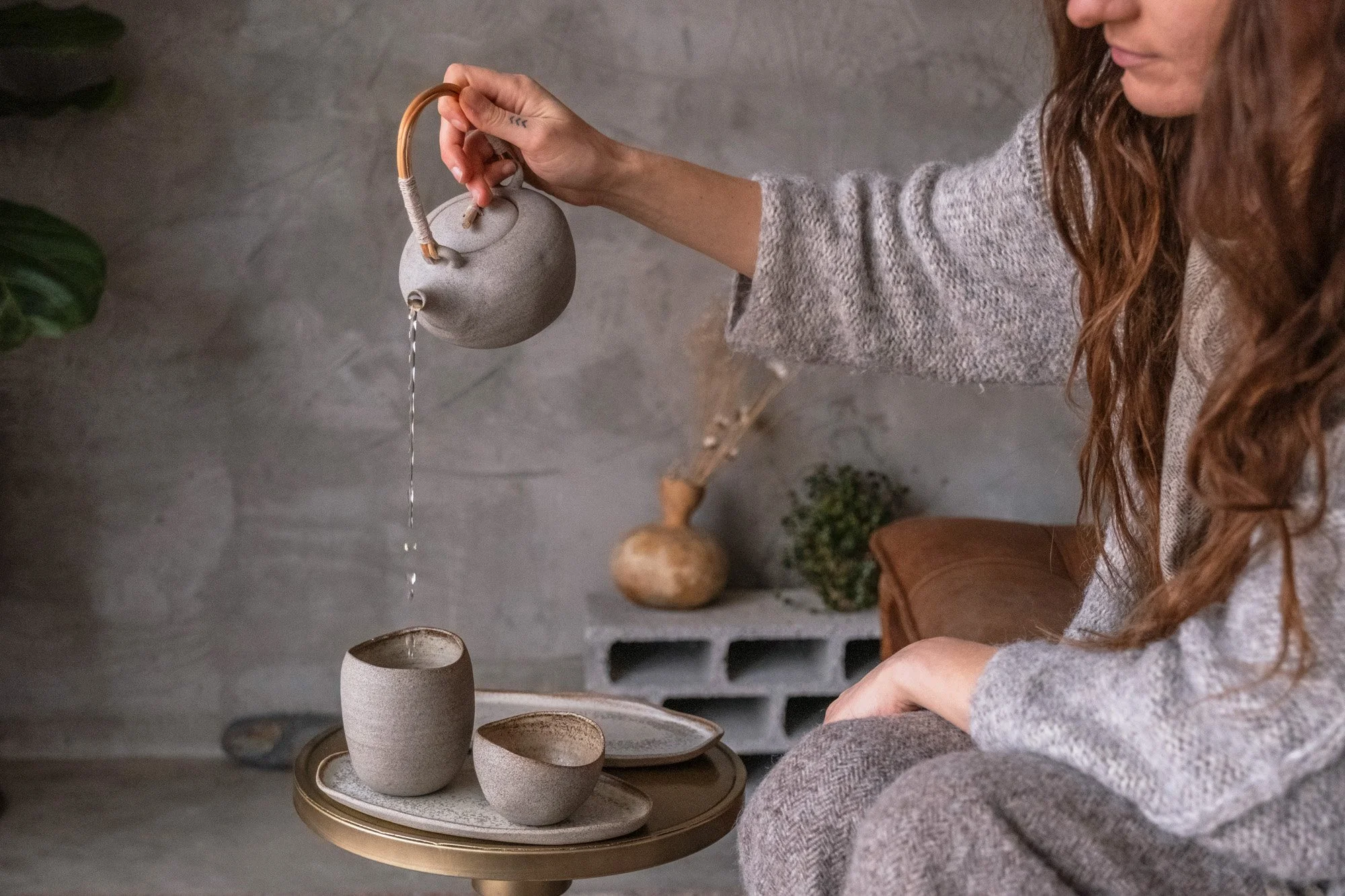
SHELL CupS and TUMBLERS
A stone-like, imperfect, rounded vessel with a subtly tucked rim. The SHELL cup is offered in two sizes — a 100 ml intimate tea or espresso companion, and a taller 300 ml version perfect for long coffees, cacao, or matcha latte..
Its form feels as though shaped by nature rather than engineered: soft contours, quiet asymmetry, and a grounding raw exterior that has been hand-polished in stages. A vessel made for slowing down, for holding close.

HOME Mug
A low, softly rounded vessel designed to feel grounding and familiar — a cup that feels like coming home. The HOME mug has a gentle, comforting silhouette with subtle wabi-sabi variation, shaped by hand to hold warmth close. Its form invites both hands to cradle it, offering a sense of steadiness and calm. Made for slow mornings, quiet evenings, and the small rituals that anchor us.
The HOME mug is the piece I have made more than any other in my entire career, and I never tire of it. Making it is effortless — it seems to bloom on the wheel all by itself: center, open, two pulls, expand, sponge out, wire off. Each time, I’m reminded that our work doesn’t always need to be hard; some forms arrive naturally, gracefully. This mug is one of them — a shape that feels as instinctive to create as it is to hold.

DUNE BOWLS
While the rest of the range is made on the pottery wheel, the DUNE bowls and plates are formed through slab rolling, allowing the stoneware to move and settle with a softer, more organic flow. Unlike the wheel-thrown pieces — which often carry two intentional, sweeping curves — the DUNE bowls develop their character through gentle hand-shaping: edges that lift and rise naturally, contours that feel almost wind-formed.
Their silhouettes echo the landscape-inspired DUNE plates, sharing the same raw, tactile exterior and quiet wabi-sabi movement. Each bowl rises slightly at the rim, creating a subtle sense of elevation — a soft lift that feels both functional and poetic.
Because of the inward-leaning rim, the bowls stack slightly higher than our classic open-profile tableware — yet they remain practical, stable, and visually harmonious within the STONE Collection. The profile creates a comforting sense of containment while still feeling spacious and light.
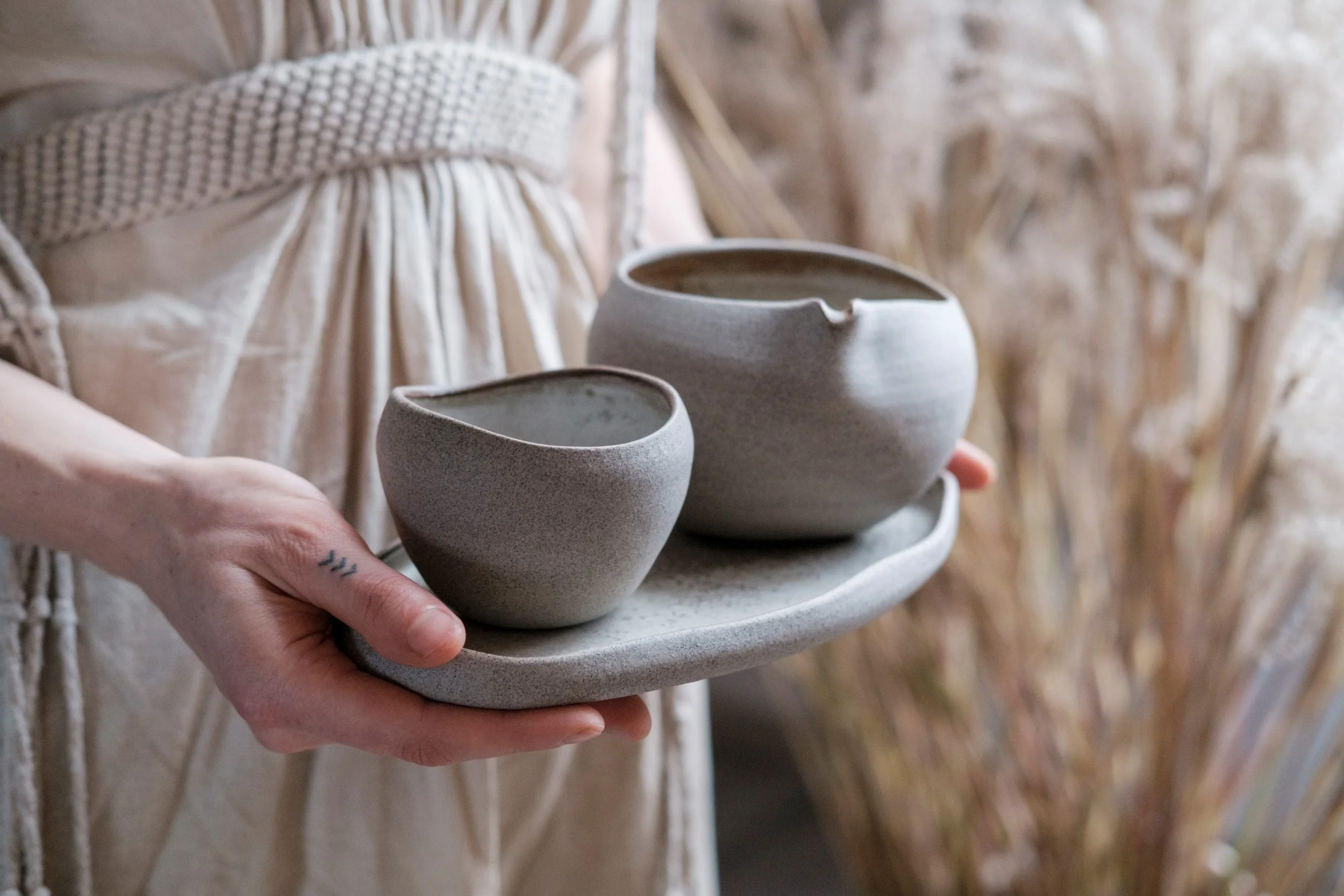
DOROTHY Jugs
Affectionately named “Dorothy,” each pitcher carries an organic, pebble-like silhouette with a small, gentle pouring spout — a form that feels as though it could be found in nature. Available in a range of sizes, from tiny creamers to generous table jugs, they sit comfortably in the hand with a soft, grounding presence.
The larger 500 ml (about 17 fl oz) version, with its low, stable form, is especially versatile — I imagine it as a beautiful vessel for matcha whisking, where its grounded shape offers both stability and space for the ritual.
Whether used for milk, sauces, water, or simply as sculptural objects, the DOROTHY jugs bring quiet elegance and natural simplicity to any setting.
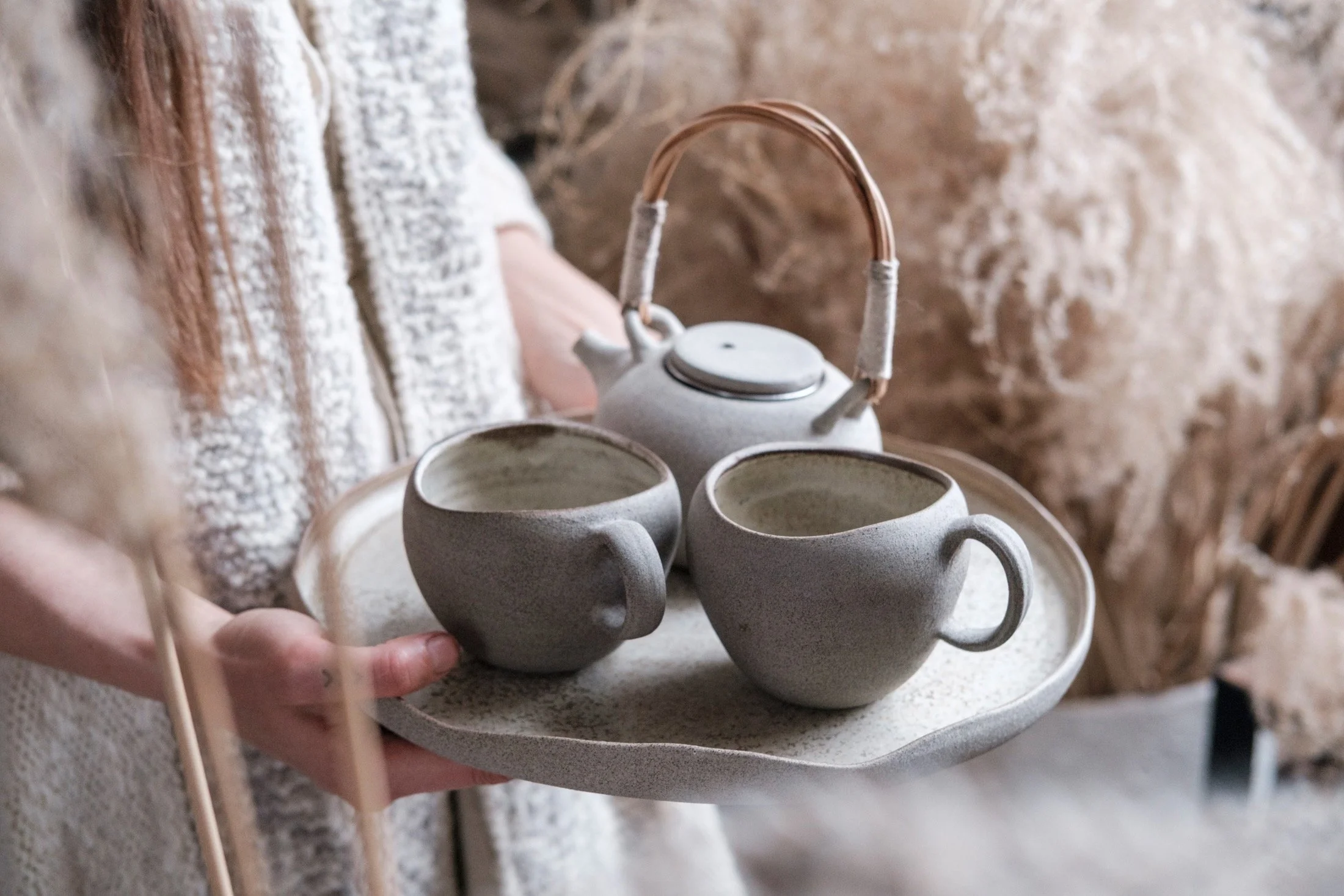
BLOOM Cup
The BLOOM cup opens like a flower: a gently widening silhouette with a soft inward tuck at the rim. Available in 200- 350 ml capacities, it’s bright and airy — distinctly a summer shape. The wide opening allows the drink to cool slightly faster, while the inward-tucked rim still gathers warmth and aroma close.
Ideal for lattes, cappuccinos, cacao rituals, matcha, and floral teas, the BLOOM cup feels expansive yet tender — holding warmth while inviting light. A vessel made for moments of calm indulgence, where the form itself seems to breathe.
After three years of making STONE, learning from it, refining it, and watching how deeply people connected to it, I finally understood:
I wanted this collection to be more accessible.
I wanted it to reach homes and hands far beyond what my two hands alone could produce.
And from that realization, the idea that would shape the next chapter of my studio began to form —
the seed of what would become the Yutori Collection.
(story to be continued…)